The AI Operating Budget Trap: Why CFOs Keep Approving Pilots But Blocking Production Scaling
Your AI pilot cost $50K and delivered impressive demos. Scaling it to production will cost $2M annually in compute, observability, governance, and engineering headcount. The gap between pilot budgets and production budgets is where enterprise AI projects go to die.
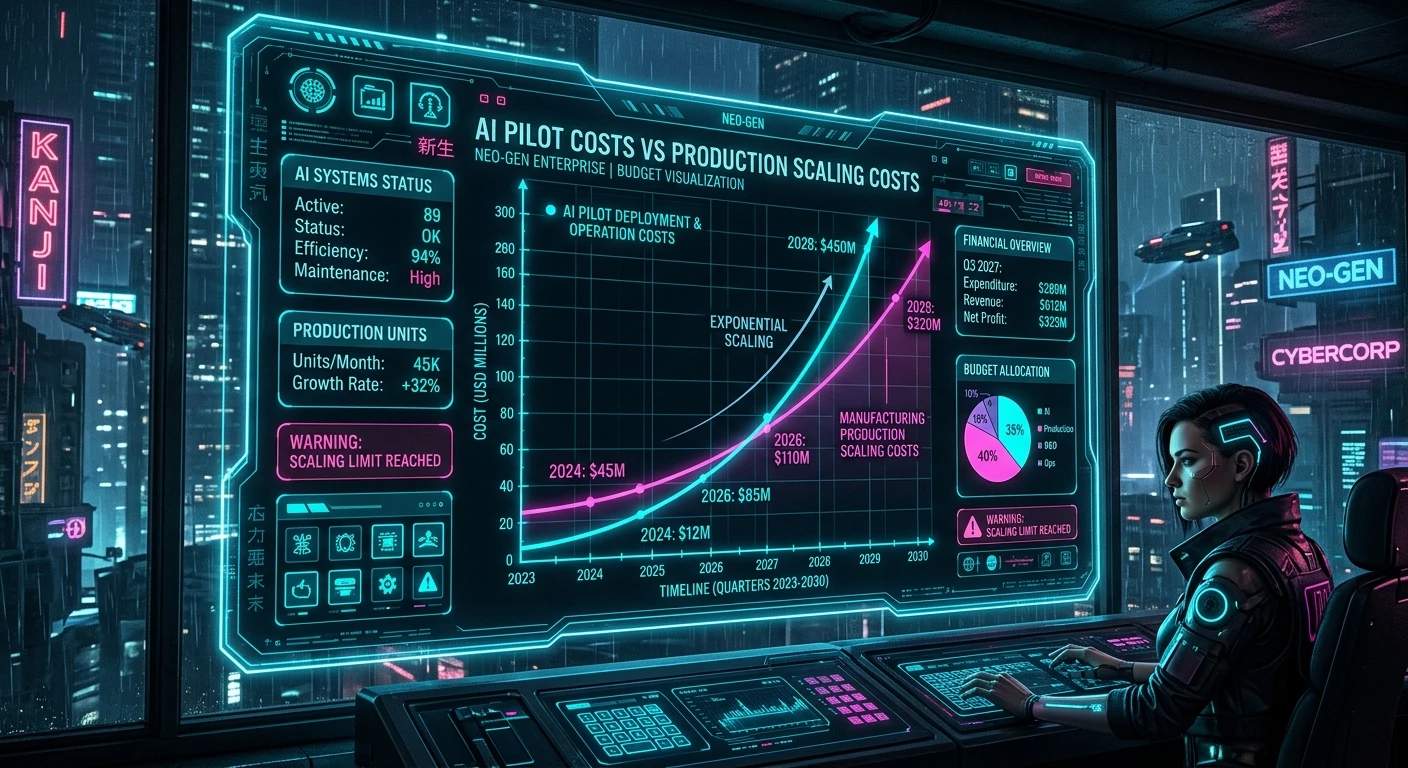
The Pilot-to-Production Budget Cliff
Every enterprise AI initiative follows the same trajectory. A small team builds a proof of concept in 8-12 weeks. It works. Stakeholders get excited. The demo is impressive. The pilot budget was manageable — some API credits, a couple of engineers' time, maybe a contractor for data labeling.
Then someone asks: "What does it cost to run this in production?"
The answer kills the project. Not because the ROI is negative — it often is not — but because the budget request looks nothing like the pilot expenditure. The pilot cost $30-75K total. Production costs $150-300K per month. CFOs who cheerfully approved the pilot recoil at the production budget because the numbers feel discontinuous. They assumed scaling was linear. It is not.
This is not a technology problem. It is a financial planning problem. And it kills more AI initiatives than technical failure ever does.
Why Production Costs Are Non-Linear
Pilot costs and production costs are not the same category of expenditure scaled up. They are fundamentally different cost structures:
Pilot costs are dominated by labor. A few engineers building for a few weeks. Compute costs are negligible because you are processing small datasets, serving a handful of internal users, and tolerating latency that would be unacceptable in production.
Production costs are dominated by infrastructure. Compute that scales with traffic. Redundancy for availability. Monitoring for reliability. Governance for compliance. Security for trust. None of these exist in a pilot — and all of them cost real money.
The specific non-linearities:
Compute scales with users, not features. Your pilot served 10 internal testers. Production serves 10,000 users. That is not a 1000x compute increase (batch processing, caching, and model optimization help) but it is typically 50-200x. At current LLM pricing, the difference between 10 and 10,000 concurrent users can easily be $100K/month in inference costs alone.
Availability requires redundancy. Your pilot ran on a single instance. If it went down, someone restarted it. Production requires multi-region deployment, automatic failover, health monitoring, and on-call engineering. These are not optional features — they are the minimum bar for systems that business processes depend on. The circuit breaker patterns that production AI systems need represent real engineering investment.
Compliance costs appear at production. While your pilot could ignore data residency, audit logging, access controls, and regulatory reporting, production systems in regulated industries cannot. Building an AI governance framework is not a one-time cost — it is an ongoing operational expense that did not exist during piloting.
Observability is not optional. Pilots fail visibly — someone notices because they are watching. Production fails silently unless you invest in observability infrastructure that detects degradation, drift, and quality regression before users do. This infrastructure costs money and requires dedicated engineering attention.
The CFO Perspective
Understanding why CFOs block production scaling requires understanding their mental model:
CFOs think in terms of CapEx versus OpEx, payback periods, and cost predictability. AI production costs violate all three expectations:
CapEx versus OpEx mismatch. Traditional software projects have high upfront development costs (CapEx) and low ongoing operational costs (OpEx). AI systems invert this: development is relatively cheap (especially with modern frameworks and pre-trained models) but operation is expensive and ongoing. CFOs budgeted for a software project. They got a utility bill.
Unpredictable scaling. Traditional software infrastructure costs are relatively predictable — you provision servers based on expected load. AI costs fluctuate with usage patterns, model complexity, and input variability. A query that is cheap on average can be expensive at the tail. CFOs cannot forecast AI OpEx with the same confidence as traditional IT costs.
No natural plateau. Traditional software reaches steady-state operational cost once deployed. AI systems face continuous cost pressure from model improvements (newer models cost more), expanding use cases (success breeds demand), and data growth (more context means more tokens). The cost trajectory is upward without obvious stabilization.
This is not irrational CFO behavior. These are legitimate concerns that AI teams typically fail to address in their business cases.
The Hidden Cost Categories
Teams that successfully scale AI to production identify cost categories that pilots never surfaced:
1. Model Management Costs
Pilots use one model. Production requires model versioning, A/B testing infrastructure, feature flags for model rollout, and the ability to roll back when new versions degrade. You also need eval-driven development infrastructure to continuously validate model quality. Budget: typically 1-2 dedicated ML engineers plus tooling costs.
2. Data Pipeline Operations
Pilots use static datasets. Production requires live data pipelines with freshness guarantees, quality monitoring, schema validation, and data contracts between teams. When your RAG system needs current data, you need ETL infrastructure running 24/7 with SLA guarantees.
3. Security and Access Control
Pilots run behind corporate VPN with team-level access. Production requires per-user authentication, role-based access, data segregation, prompt injection defense, and output filtering. For AI agent systems, you need capability-based access control that governs what the AI itself can do — not just who can use it.
4. Incident Response
Pilots do not have incidents — they have bugs that get fixed next sprint. Production AI systems have incidents that require immediate response: model hallucinating confidently, agent taking harmful actions, data leakage between tenants, cost runaway from recursive queries. You need on-call rotations, runbooks, and the ability to intervene in real-time.
5. Continuous Improvement
Pilots ship and stop. Production AI systems require continuous improvement: retraining on new data, prompt optimization, evaluation against evolving requirements, user feedback integration. This is not maintenance — it is ongoing development that never ends. Budget for it as permanent headcount, not project allocation.
The Business Case That Actually Works
The standard AI business case fails because it extrapolates pilot costs to production. Here is the structure that gets CFO approval:
Frame it as operational infrastructure, not a project. AI in production is not a software project with a completion date. It is operational infrastructure like your CRM or ERP — ongoing, critical, and budgeted annually. CFOs understand annual infrastructure budgets. They do not understand "projects" that cost more every year with no end date.
Show the cost curve, not a point estimate. Present production costs as a function of usage: "At 1,000 daily users, monthly cost is X. At 10,000, it is Y. Here is what drives the curve and here is where optimization reduces slope." This gives CFOs the predictability model they need. It also demonstrates that you understand the cost dynamics rather than guessing.
Quantify the cost of NOT scaling. The pilot demonstrated value. If you do not scale it, that value is locked in a demo. Calculate what the organization loses by NOT having this capability in production — manual labor hours, error rates, cycle time, competitive disadvantage. Frame the production budget as the cost of unlocking value that already proved itself.
Build in cost engineering from day one. Show that your production architecture includes explicit cost engineering strategies: semantic caching, model routing to cheaper models for simple queries, batch processing where latency allows, aggressive prompt optimization. Demonstrate that you have a plan to manage costs downward over time, not just absorb them.
Phase the investment. Do not ask for the full production budget upfront. Propose a phased rollout: limited production (100 users) at budget X, scaled production (1,000 users) at budget Y after demonstrating cost efficiency at the smaller scale. Each phase proves cost predictability before the next phase is funded.
The Architecture Decisions That Determine Budget
Critical architectural choices made during the pilot phase lock in production cost structures. Teams that want manageable production budgets must make these decisions deliberately:
Model selection strategy. Using GPT-4 or Claude Opus for everything during a pilot is fine. In production, you need a tiered approach: expensive models for complex reasoning, cheap models for simple classification, and local models for latency-sensitive operations. This requires hot-swap model routing architecture built from the start.
Caching architecture. In pilots, every request hits the model. In production, semantic caching can reduce model calls by 40-70% for many applications. But caching architecture must be designed in — it cannot be bolted on after deployment without significant rework.
Batch versus real-time. Pilots process everything in real-time because there is no queue depth. Production must distinguish between requests that need immediate response and those that can be batched for efficiency. This distinction requires architectural support and product decisions about acceptable latency.
Self-hosted versus API. Pilot economics almost always favor API calls (pay-per-use, no infrastructure management). Production economics often favor self-hosted models for high-volume, predictable workloads. The crossover point depends on your specific usage patterns — but failing to evaluate it means paying cloud markup on every inference forever.
The Governance Tax
Regulated industries face an additional cost layer that unregulated startups avoid: the governance tax.
Financial services, healthcare, and government organizations cannot deploy AI systems without audit trails, explainability documentation, bias testing, model validation, and regulatory reporting. This is not bureaucratic overhead — it is legal compliance.
The governance tax adds:
- 30-50% to development timelines (documentation, review cycles, approval gates)
- 20-40% to operational costs (audit logging, monitoring, reporting infrastructure)
- 1-2 additional roles (AI governance officer, compliance integration specialist)
Teams in regulated industries that budget production AI without the governance tax will either blow their budget or ship non-compliant systems. Neither outcome is acceptable.
What Successful Scaling Looks Like
Organizations that successfully navigate the pilot-to-production transition share common patterns:
They budget for production from day one. The pilot business case includes a production cost estimate. Leadership approves the pilot knowing what production will cost. There is no sticker shock because the number was never hidden.
They build cost controls into the architecture. Rate limiting, budget caps per tenant, usage-based throttling, and cost alerting are architectural features, not afterthoughts. If production costs exceed projections, the system degrades gracefully rather than bankrupting the project.
They measure value continuously. Monthly reporting shows: what the system costs, what value it produces, and what the unit economics look like (cost per decision supported, cost per hour saved, cost per error prevented). This ongoing value demonstration prevents budget reviews from becoming existential threats.
They plan for cost optimization phases. After initial production deployment, dedicated engineering sprints focus exclusively on cost reduction without capability reduction: prompt optimization, cache warming, model downsizing, architecture refinement. A 30-40% cost reduction in the first year of production is achievable for most systems with deliberate engineering effort.
As explored in the build trap in enterprise AI, the decision of what to build versus buy also significantly impacts long-term cost structures. Custom-built systems offer optimization potential but require ongoing engineering investment. Platform products offer predictable pricing but limited optimization levers.
The Three-Budget Model
I recommend enterprises adopt a three-budget model for AI initiatives:
Budget 1: Exploration (Pilot). Time-boxed, small, focused on proving feasibility and estimating production economics. Success criteria: demonstrated value AND a credible production cost model. Typical: $30-100K over 8-12 weeks.
Budget 2: Foundation (Initial Production). Deploying to a limited user base with full production architecture but restricted scale. Success criteria: validated cost model, demonstrated reliability, confirmed user value at production quality levels. Typical: $150-400K over 3-6 months including infrastructure buildout.
Budget 3: Scale (Full Production). Expanding to full user base with optimized cost structure. Success criteria: unit economics that improve over time, measurable business impact, cost predictability within 15% of forecast. Typical: $1-3M annually for significant enterprise deployments.
Each budget gates the next. CFOs approve one phase at a time with clear criteria for progression. This eliminates the single massive budget request that triggers rejection reflexes while maintaining momentum through the scaling journey.
The Strategic Imperative
Here is the uncomfortable truth: the organizations that figure out AI production economics in 2026 will have compounding advantages over those that do not.
AI capabilities improve continuously. The cost of NOT deploying grows every quarter as competitors capture the value you are leaving on the table. But deploying without cost discipline burns through budgets and creates CFO skepticism that blocks future initiatives.
The answer is not "convince the CFO to write a bigger check." The answer is: build cost engineering into your AI practice as a first-class discipline. Treat production economics as an architectural concern, not a financial afterthought. And present budgets that demonstrate you understand and can manage the cost dynamics that make CFOs nervous.
The AI-native operating model is not just about what AI can do. It is about building the financial and operational discipline to sustain AI capabilities at scale without budget crises that reset progress to zero.
Struggling to get AI past pilot stage? Need a production cost model that CFOs will actually approve? Book a strategy session to build a credible production business case for your AI initiative.
Founder & Principal Architect
Ready to explore AI for your organization?
Schedule a free consultation to discuss your AI goals and challenges.
Book Free Consultation