Checkpoint and Replay Patterns for Long-Running AI Agents: Why Stateless Retries Fail at Scale
Your agent crashes four hours into a twelve-hour workflow and restarts from zero. Without checkpoint-replay architecture, long-running agents are expensive, unreliable, and impossible to debug.
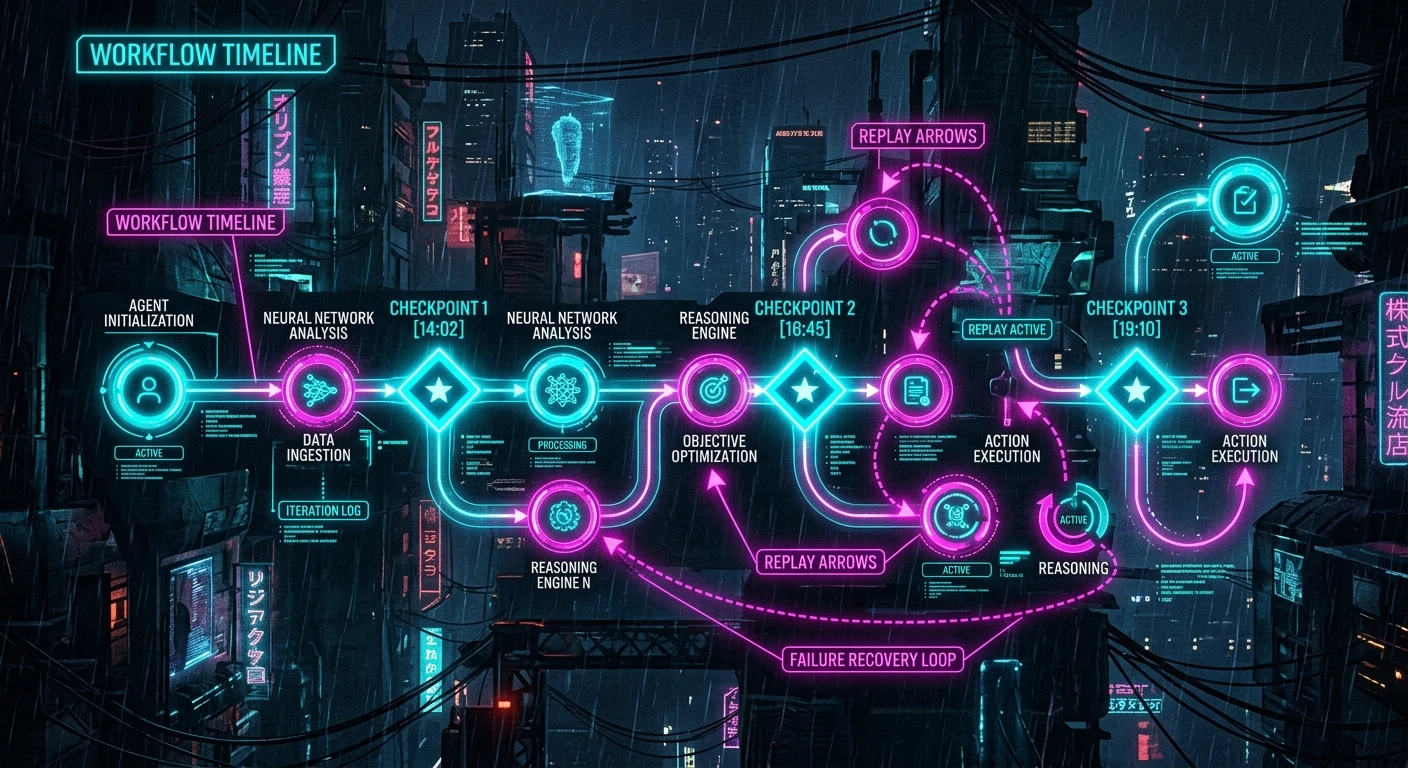
The Twelve-Hour Agent Problem
Modern AI agents are not request-response systems anymore. They run multi-hour research workflows, process thousands of documents sequentially, orchestrate multi-step data transformations, and manage week-long campaign deployments. These are not five-second tool calls. They are stateful processes that accumulate context, make sequential decisions, and build on intermediate results over extended periods.
When a twelve-hour agent workflow fails at hour eight, the naive approach is retry-from-start. You lose eight hours of LLM inference costs, eight hours of accumulated context, and eight hours of intermediate decisions that cannot be perfectly reproduced because model outputs are non-deterministic. Your customer waits another twelve hours for results that were 67% complete when the failure occurred.
This is not an edge case. In production agent systems with multi-step pipelines, failure rates compound multiplicatively. A pipeline with twenty steps at 99% individual reliability delivers end-to-end success only 82% of the time. At fifty steps, you are below 61%. Without checkpoint-replay, every failure means full restart.
Why Traditional Retry Logic Breaks
Distributed systems solved this decades ago for deterministic workflows. Database transactions checkpoint to write-ahead logs. MapReduce checkpoints between shuffle stages. Spark persists RDDs to disk at stage boundaries. These patterns assume reproducibility: given the same input, the same step produces the same output.
AI agents violate this assumption fundamentally. The same prompt with the same context produces different outputs across invocations. Temperature, model version changes, provider-side batching, and even time-of-day load patterns affect responses. Replaying an agent from step one does not reproduce the path that led to step eight. Your checkpoint-replay system must preserve the actual outputs, not just the inputs that theoretically reproduce them.
This connects to why idempotency patterns for agent actions require fundamentally different approaches than traditional distributed systems. The non-determinism is not a bug to fix — it is a property of the medium.
Checkpoint Architecture for Non-Deterministic Systems
Effective agent checkpointing requires capturing three distinct state layers:
Execution state. Which steps have completed, which are pending, what is the current position in the workflow graph. This is the easiest layer — equivalent to a program counter plus call stack.
Accumulated context. The outputs of every previous step that inform future decisions. In a research agent, this includes every document retrieved, every summary generated, every relevance judgment made. This layer grows linearly and is often the largest checkpoint payload.
Decision trace. The reasoning chain that connects steps. Why did the agent choose to explore topic A before topic B? What confidence thresholds triggered branching decisions? Without the decision trace, you cannot meaningfully resume — you can only restart from the last output with no understanding of strategic direction.
The storage strategy matters. Naive approaches serialize entire agent state to a single blob. This works for small agents but fails at scale because (1) serialization time grows linearly with accumulated context, (2) checkpoint writes block execution during the write, and (3) restoration requires loading the full state even when only the most recent context window matters.
Incremental checkpointing solves this: each step appends its output to an append-only log, and the agent state is reconstructable from the log prefix up to any step. This is essentially event sourcing applied to agent execution, and it gives you replay as a natural consequence of the architecture.
Replay Semantics: Exact vs. Equivalent
When you replay from a checkpoint, you face a semantic choice: do you want exact replay (reproduce the identical execution path) or equivalent replay (reach a functionally similar end state through potentially different intermediate steps)?
Exact replay requires persisting the actual LLM responses at each step and feeding them back as cached responses during replay. This is deterministic but brittle — if any downstream step depends on external state that has changed (a database updated, an API response differs), exact replay diverges from reality.
Equivalent replay re-executes steps from the checkpoint with live model calls, accepting that the path may differ while the destination remains functionally equivalent. This is more robust but requires validation: how do you know the replayed execution reached an equivalent state without running it to completion?
Production systems typically use hybrid approaches: exact replay for steps with side effects (you do not want to send the same email twice) and equivalent replay for pure computation steps where the specific wording matters less than the semantic content. The circuit breaker patterns that protect against cascading failures also apply here — failed replays should degrade gracefully rather than attempt infinite retries.
Checkpoint Granularity Decisions
Checkpointing every single LLM call maximizes recoverability but imposes storage and latency costs. Checkpointing only at major stage boundaries minimizes overhead but increases rework on failure. The optimal granularity depends on three factors:
Step cost. Expensive steps (long-running tool calls, large document processing, external API calls with rate limits) deserve individual checkpoints. Cheap steps (simple format transformations, small classification calls) can be grouped.
Step determinism. Steps with high output variance across invocations need checkpointing more than steps that reliably produce similar outputs. A summarization step that varies significantly needs its output preserved; a JSON parsing step does not.
Failure probability. Steps that historically fail more often (network-dependent calls, resource-constrained operations, steps that trigger rate limits) should have checkpoints immediately before them so failures recover without re-executing preceding work.
Most production systems settle on checkpointing at "semantic boundaries" — points where the agent has completed a coherent unit of work that has standalone value. A research agent might checkpoint after each source is fully processed, not after each individual paragraph extraction. This maps naturally to how observability for AI systems defines meaningful trace spans.
Implementation Patterns
Pattern 1: Workflow-as-DAG with persistent edges. Model your agent workflow as a directed acyclic graph where each edge carries the output of the source node. Completed nodes are marked in durable storage. On failure, walk the DAG to find the frontier of completed nodes and resume from there. Works well for workflows with clear stage structure.
Pattern 2: Event-sourced execution log. Every agent action (LLM call, tool use, decision point) appends an event to a durable log. Agent state is a projection over this event stream. Resume by replaying the event stream up to the failure point, then continuing with live execution. Most flexible pattern but requires careful event schema design.
Pattern 3: Saga pattern with compensating actions. For agents that produce side effects (send emails, update databases, create tickets), each effectful step registers a compensating action. On failure, the system can either resume forward from the last checkpoint or roll back by executing compensating actions in reverse. Essential for agents that interact with external systems where partial completion creates inconsistent state.
The choice between these patterns depends on your agent topology. Linear pipelines suit Pattern 1. Exploratory agents with branching behavior suit Pattern 2. Agents with external side effects require Pattern 3 regardless of other choices.
Debugging Long-Running Failures
Checkpoint-replay is not just a reliability pattern — it is a debugging superpower. When a twelve-hour agent produces unexpected output, checkpoint-replay lets you:
- Identify the exact step where behavior diverged from expectations
- Inspect the accumulated context at that step to understand what the agent "saw"
- Replay from that specific checkpoint with modified prompts or parameters to test hypotheses
- Compare parallel replays with different interventions to isolate causal factors
Without checkpoints, debugging a long-running agent failure means re-running the entire workflow with logging enabled and hoping the failure reproduces. With checkpoints, you have a time-travel debugger for non-deterministic AI systems.
This capability directly supports the eval-driven development approach — checkpoints become the fixtures for your agent evaluation suite, letting you test specific decision points without paying the cost of full pipeline execution.
Cost Engineering Implications
Checkpoint-replay has direct cost implications that most teams underestimate. Consider a research agent that processes 500 documents over six hours, spending approximately $40 in LLM inference. Without checkpointing, a failure at document 400 costs $40 in wasted compute plus $40 for the retry — $80 total for one successful run. With checkpointing, the retry costs only $8 (the remaining 100 documents) plus minimal storage costs for the checkpoint data.
At scale, the math becomes compelling. If your agent fleet runs 100 long-running jobs daily with a 15% failure rate, checkpoint-replay saves roughly 60% of your retry compute budget. This connects directly to cost engineering for LLM applications — reliability architecture is cost architecture.
The Bottom Line
Long-running AI agents without checkpoint-replay are the equivalent of writing a novel without saving — one crash erases everything. The non-deterministic nature of LLM-based systems means you cannot simply re-run from the beginning and expect identical results. Checkpoint-replay gives you resumability, debuggability, and cost efficiency simultaneously. If your agents run longer than five minutes, this is not optional infrastructure — it is table stakes for production reliability.
Founder & Principal Architect
Ready to explore AI for your organization?
Schedule a free consultation to discuss your AI goals and challenges.
Book Free Consultation