Dead Letter Queues for AI Agent Failures: Why Silent Drops Are Your Biggest Production Blind Spot
Your agent pipeline fails silently dozens of times per day. Without dead letter queues designed for non-deterministic systems, you cannot distinguish between recoverable failures and systemic collapse until users notice.
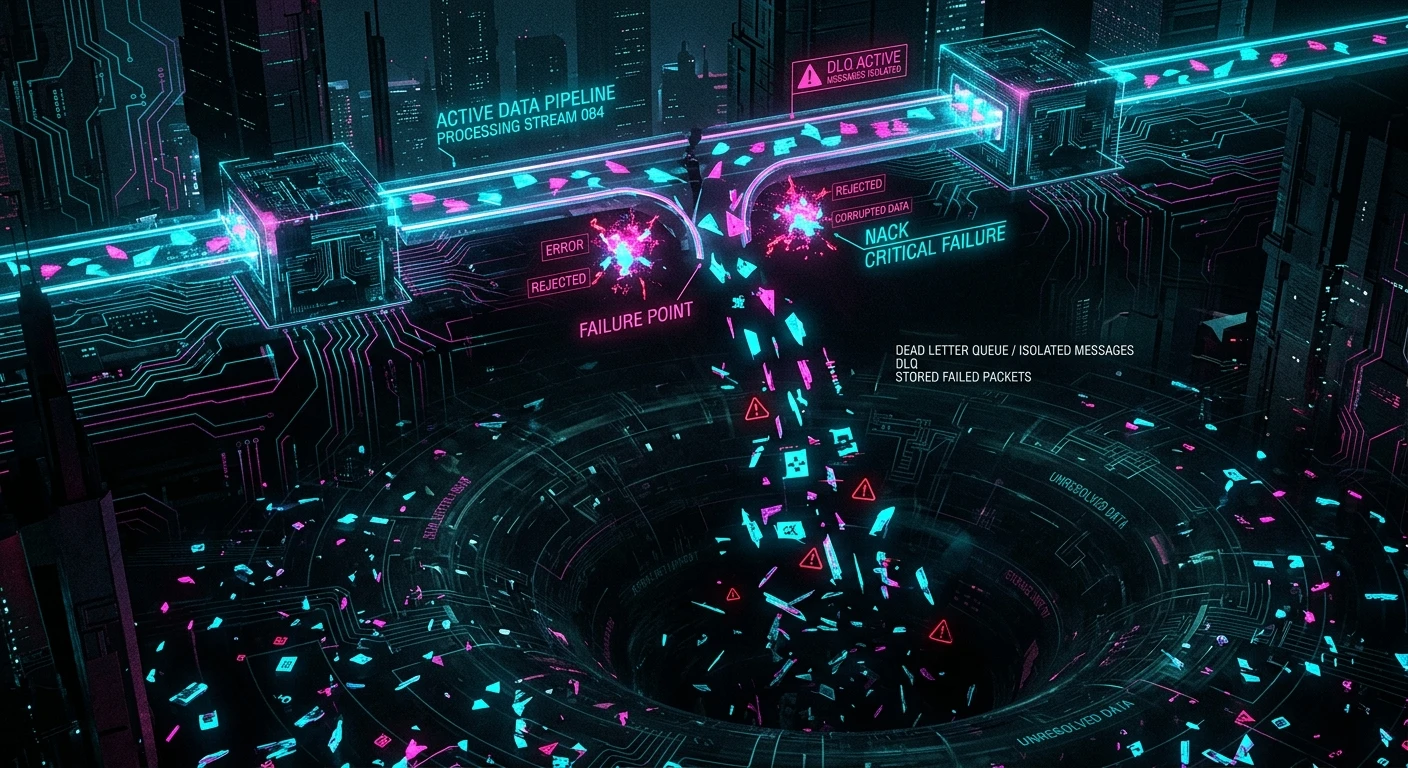
The Silent Failure Epidemic
Every production AI agent system I have audited in the past year shares the same blind spot: failures that produce no signal. The agent attempts a tool call, receives an ambiguous response, decides to skip that step, and continues with degraded output. No error. No alert. No log entry that anyone monitors. The user gets a worse result and nobody knows why.
In traditional distributed systems, this class of problem is solved by dead letter queues (DLQs) — holding areas for messages that cannot be processed, where they accumulate until someone investigates. But AI agent pipelines do not use DLQs because the failure modes do not look like traditional message processing failures. The agent did not crash. It did not throw an exception. It made a decision — a bad one — and moved on.
This is why silent drops are your biggest production blind spot. Not model hallucination, not prompt injection, not cost overruns. Silent drops. Because every other failure mode eventually produces a signal. Silent drops produce nothing until aggregate quality degrades far enough that users complain.
Why Traditional DLQ Patterns Break for AI
Traditional dead letter queues trigger on clear failure signals: message parsing errors, consumer exceptions, retry exhaustion. The contract is binary — a message either processes successfully or it does not.
AI agent systems break this contract in three ways:
Partial success ambiguity. An agent tasked with researching a topic might successfully call three of five planned sources, fail on two (timeout, rate limit, parsing error), and still produce a response. Is this a success or a failure? The agent thinks it succeeded. The output looks plausible. But it is missing forty percent of the information it should contain.
Graceful degradation masking. Agents are designed to be resilient — if one approach fails, try another. This resilience is a feature in demos and a liability in production because it means failures get absorbed rather than surfaced. The agent that cannot access the database falls back to cached data without reporting the database failure. As we explored in circuit breaker patterns for agent pipelines, graceful degradation needs explicit boundaries or it becomes silent degradation.
Non-deterministic success criteria. What constitutes a successful agent execution? The answer depends on context, user intent, and quality thresholds that are themselves fuzzy. You cannot write a simple boolean check for "did this agent do its job well" the way you can check "did this API return 200."
Designing DLQs for Non-Deterministic Systems
The solution is not to abandon the DLQ pattern but to redefine what constitutes a dead letter in agentic systems. Instead of binary success/failure, you define quality envelopes and route executions that fall outside them:
Confidence-gated routing. Every agent action produces (or should produce) a confidence signal. Tool calls that return ambiguous results, context retrievals with low similarity scores, generations that trigger guardrail warnings — these should route to a dead letter queue even if the overall execution continues. You are not stopping the agent; you are creating a parallel audit stream of degraded-quality steps.
Budget exhaustion tracking. When an agent consumes its latency budget on retries and fallbacks, the final output may be technically complete but operationally degraded. Track budget consumption as a DLQ trigger: any execution that consumed more than 80% of its budget on recovery rather than primary work needs investigation.
Output delta detection. Compare agent outputs against recent baselines. If today's outputs are systematically shorter, less detailed, or missing sections that were present yesterday, route the delta to a DLQ for investigation. This catches the slow degradation that no individual execution triggers an alert for.
Architecture Pattern: The Agent DLQ Pipeline
Here is the architecture that works in production:
Layer 1: Execution wrapper. Every tool call, retrieval, and generation step runs inside a wrapper that captures metadata: latency, retry count, confidence scores, fallback triggers, token consumption. This metadata flows to a sidecar, not the main execution path.
Layer 2: Quality envelope evaluator. An async process evaluates each execution's metadata against defined envelopes. Executions inside the envelope pass silently. Executions outside route to the DLQ with full context: what the agent was trying to do, what went wrong, what fallback it chose, and what the output looked like.
Layer 3: Pattern aggregator. Individual dead letters are noise. Patterns are signal. The aggregator groups dead letters by failure mode, affected agent, time window, and upstream dependency. When a pattern crosses a threshold ("twelve executions hit database timeout in the last hour"), it promotes to an alert.
Layer 4: Replay infrastructure. The most valuable property of a DLQ is replayability. Dead-lettered agent executions should be replayable with the original context once the underlying issue is fixed. This requires capturing not just the failure but the full execution state at the point of failure — similar to how idempotency patterns ensure safe replay of agent actions.
What Belongs in an Agent DLQ
Not every suboptimal execution belongs in a DLQ. Overfilling it creates alert fatigue and makes the queue useless. Route to the DLQ:
- Tool calls that returned errors but the agent continued anyway
- Retrieval operations with similarity scores below your quality threshold
- Generations that triggered guardrail partial matches (not hard blocks)
- Executions where retry count exceeded two for any single step
- Outputs missing expected sections compared to the prompt template
- Any execution where the agent explicitly chose a fallback path
Do NOT route to the DLQ:
- Normal variance in output length or style
- Expected empty results (user asked about something that does not exist)
- Intentional fallbacks within designed degradation boundaries
- Executions that completed within budget on the first attempt
The Operational Payoff
Teams that implement agent DLQs report three immediate benefits:
Failure mode discovery. You cannot fix what you cannot see. DLQs reveal failure patterns you did not know existed — a particular tool that fails every Tuesday during batch processing, a retrieval source that degrades under concurrent load, a prompt that produces low-confidence outputs for certain input patterns. This connects to the broader challenge of observability for AI systems — DLQs are the missing observability layer for decision quality.
Quality trend tracking. By measuring DLQ volume over time, you get a leading indicator of system health. Rising DLQ volume means something is degrading — often days before users notice. This is the AI equivalent of error budget burn rate in SRE.
Regression detection. When you deploy a new model version, prompt change, or tool integration, DLQ volume tells you immediately whether quality improved or degraded. No need to wait for user feedback or run manual evaluations. The approach aligns with how teams practicing eval-driven development use automated signals to catch regressions.
The investment is modest — a metadata sidecar, an async evaluator, and a pattern aggregator. The return is transforming your agent system from a black box that either works or does not into an observable system where you can see exactly where and how quality degrades.
Implementation Priorities
If you are building this today:
- Start with tool call wrappers. Capture success/failure/ambiguous for every external call. This alone reveals more than most teams have visibility into.
- Define three quality envelopes: response completeness, latency budget, and confidence threshold. Route violations to a simple queue (even a database table works initially).
- Build a daily digest that groups dead letters by pattern. Do not alert on individual items.
- Add replay capability once you have enough volume to justify it.
The teams running production AI systems successfully — the ones whose agents actually improve over time rather than slowly degrading — all have some version of this pattern. They know what their agents fail at because they built infrastructure to capture the failures that agents themselves do not report. The parallel to how the best research operations track insight quality is direct: you measure what matters, or you fly blind.
Founder & Principal Architect
Ready to explore AI for your organization?
Schedule a free consultation to discuss your AI goals and challenges.
Book Free Consultation