The Embedding Drift Problem: Why Your RAG System Silently Degrades Every Time You Re-Index
Your retrieval-augmented system worked beautifully at launch, and it still returns results with the same confident latency today -- but the answers have quietly gotten worse. Nobody changed the model, nobody touched the prompts, and every dashboard is green. What changed is the one thing nobody versioned: the embeddings. Embedding drift is the silent decay that sets in when the vectors you query against no longer live in the same semantic space as the vectors you stored, and it is the reason RAG systems rot without a single alert firing.
The System That Rotted While Standing Still
Here is a failure that never shows up in an incident channel. A retrieval-augmented generation system ships, passes eval, and delights everyone for a quarter. Latency is flat. Error rates are zero. The model provider has not deprecated anything. And yet, slowly, the answers get vaguer, the citations get less relevant, and the humans who rely on it start quietly routing around it. By the time someone runs a real evaluation, retrieval quality has fallen off a cliff -- and no deploy, no config change, and no model swap appears anywhere in the timeline.
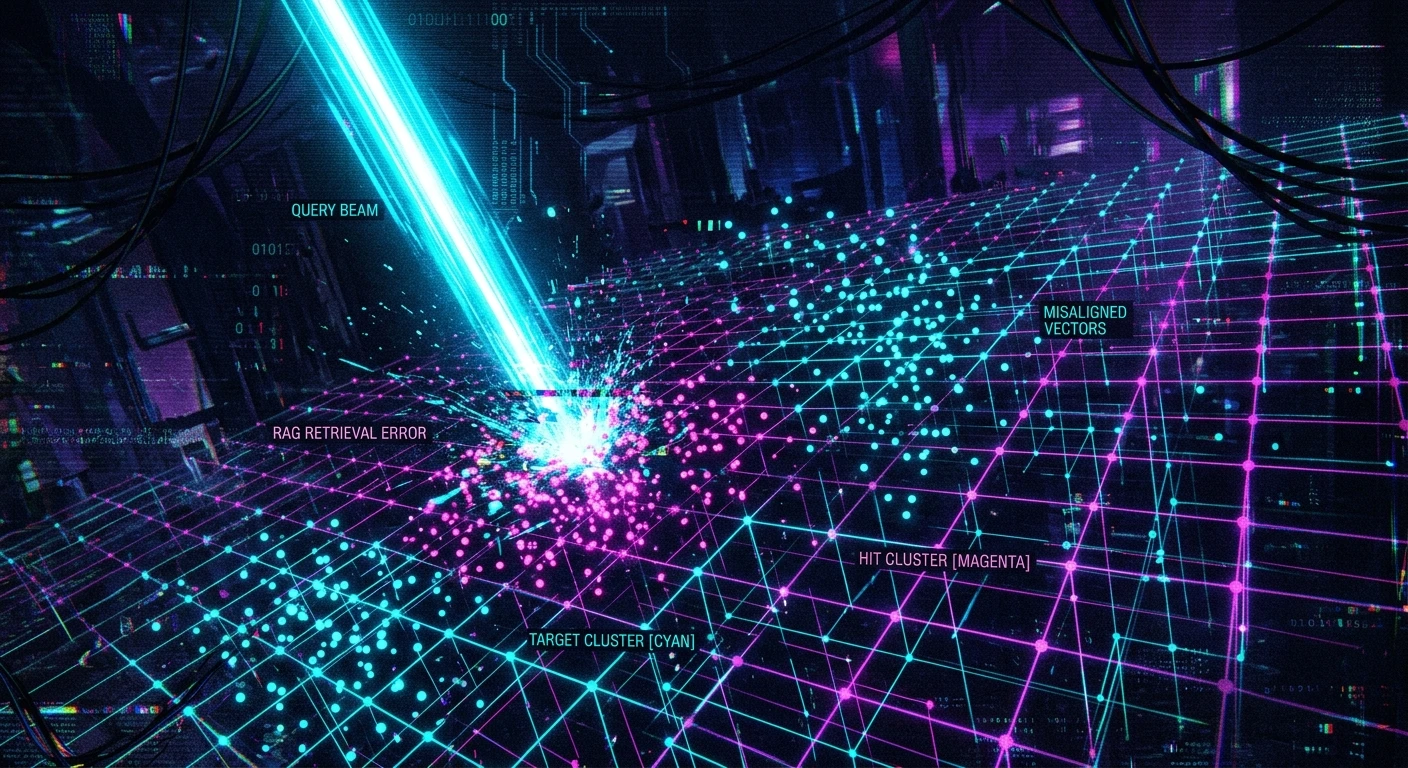
The culprit is embedding drift: the gradual divergence between the vector space your documents were embedded into and the vector space your queries are embedded into today. RAG systems treat the embedding as an invisible, permanent coordinate. It is neither. Embeddings are produced by a model, and the moment that model, its version, its tokenizer, its preprocessing, or its normalization changes even slightly, the coordinates shift. Old vectors and new vectors stop meaning the same thing, and cosine similarity -- the entire basis of your retrieval -- starts comparing apples to a subtly different orchard.
The reason this is so insidious is that nothing breaks loudly. A drifted embedding still returns a number. A misaligned query still retrieves ten chunks. The pipeline runs green end to end. You have built a system whose core assumption -- that stored and query vectors are commensurable -- can silently become false while every health check keeps passing.
Where the Drift Actually Comes From
Embedding drift is not one bug; it is a family of them, and most teams have more than one.
Model version drift. You call a hosted embedding endpoint. The provider ships a minor update -- better multilingual handling, a tokenizer tweak, a normalization change. Your query embeddings now come from a slightly different function than the one that embedded your corpus months ago. The two spaces no longer align, and similarity scores degrade in ways no version string in your logs will explain. This is the retrieval-layer instance of the model provenance gap, where you cannot prove which model produced a given output in production.
Partial re-index drift. You re-embed new documents with the current model but leave the old corpus untouched to save compute. Now your index is a blend of two embedding generations occupying overlapping-but-shifted spaces. Queries systematically favor whichever generation matches the query embedder, and relevance quietly tilts toward the freshly indexed slice regardless of actual content quality.
Preprocessing drift. The embedding model is identical, but the text you feed it changed -- a new chunking strategy, different whitespace normalization, stripped markdown, changed metadata prepending. Same model, different inputs, different vectors. The corpus and the queries were prepared by different code paths, and the space fractures along that seam.
Distributional drift. The model and pipeline are frozen, but the queries themselves migrate. Users start asking about topics, entities, and phrasings that were rare or absent when the corpus was built. The embedding space is fine; your corpus simply no longer covers where the queries now live, and retrieval returns the nearest irrelevant thing with full confidence.
This last mode is the retrieval cousin of configuration drift in AI systems, where the running reality diverges from the specification nobody re-checked. The spec says "we have coverage." The distribution says otherwise. Nobody reconciled them.
Why Your Dashboards Cannot See It
Standard observability is built for failures that produce signals -- exceptions, latency spikes, error codes. Embedding drift produces none of these. Every layer reports success:
The embedding call returns a 200 and a well-formed vector. The vector store returns k neighbors with plausible similarity scores. The LLM receives context and produces a fluent answer. The user gets a response in 400 milliseconds. Green, green, green, green.
What no layer measures is whether the retrieved chunks were actually the right ones. Similarity score is not relevance; it is proximity in a space that may have quietly shifted. A drifted system returns high-similarity, low-relevance chunks and reports the high similarity as if it were health. This is precisely the silent failure mode in agentic AI, where success metrics measure the wrong thing and mask degradation. Your retrieval metric is measuring geometry, not usefulness, and geometry looks fine right up until someone reads the answers.
The absence of a hard failure is exactly what makes drift dangerous. A crash gets fixed in an hour. A slow, silent decay in relevance can run for a quarter, poisoning every downstream decision that trusted the retrieved context, before anyone thinks to question a system that never once threw an error.
Engineering Against Drift
Closing the embedding drift gap is not about picking a better embedding model. It is about refusing to treat embeddings as timeless coordinates and instead governing them as versioned, monitored, testable artifacts.
Version the embedding space itself. Every vector in your store should carry the embedding model version, tokenizer version, and preprocessing pipeline hash that produced it. A query embedded with version B should never be silently compared against corpus vectors from version A. Make the space a first-class, tagged artifact -- the same discipline that closes the model provenance gap applies directly to the retrieval layer.
Re-index atomically, never partially. When you change embedding models or preprocessing, re-embed the entire corpus into a new namespace and cut over atomically once it is complete. A blended index is a corrupted index. If full re-embedding is expensive, that cost is the real price of changing your embedding model -- budget for it rather than hiding it as a mixed-generation store.
Pin hosted embedding versions and treat upgrades as migrations. Never point production retrieval at a floating "latest" embedding endpoint. Pin the version, and when you upgrade, run it as a deliberate migration with a full re-index and a re-evaluation -- not as a transparent provider change you inherit without noticing. Treat an unpinned embedding dependency the way you would treat an unversioned schema.
Enforce a retrieval contract. Define, explicitly, what a query must retrieve to be considered correct -- a golden set of query-to-document expectations that you assert against continuously. This is a data contract for the retrieval layer: the query side and the corpus side agree on what "relevant" means, and any drift that violates the contract fails a check instead of quietly degrading a user experience.
Measure relevance, not similarity. Stand up an eval-driven harness that tests retrieval quality against ground truth on every corpus or model change, and run a slice of it continuously in production against a fixed golden set. When mean relevance on the golden set drops, you have caught drift the day it starts, not the quarter it finishes.
Instrument retrieval as a monitored surface. Track relevance-graded metrics, query-distribution shift, and score distributions over time as first-class signals -- not just latency and error rate. This is where mature observability for AI systems earns its keep: the goal is to make silent semantic decay produce a visible signal, so a shifting space trips an alert instead of eroding trust.
The Governance Angle Nobody Budgets For
Embedding drift is not merely an engineering nuisance; it is a governance liability. If your RAG system informs decisions -- what a support agent tells a customer, what a compliance tool surfaces, what an internal copilot recommends -- then the relevance of retrieved context is part of your decision quality. A silently drifting index means the basis for those decisions changed without any recorded change, and you cannot reconstruct why an answer was good in March and misleading in June.
That is an auditability failure. When an enterprise cannot explain why its retrieval degraded, it is exposed to the same class of risk as any system that cannot show its work, which is why audit trails and explainability for enterprise AI must extend down into the retrieval layer, not stop at the model output. The provenance of the context is part of the provenance of the answer. If you version the model but not the embedding space, you have audited half the system and called it governed.
The Bottom Line
RAG systems do not fail on the day they rot. They rot quietly, over weeks, as embedding spaces drift apart, corpora fall behind query distributions, and provider upgrades slip in beneath unpinned dependencies -- all while every dashboard stays green because similarity scores keep looking healthy even as relevance collapses. The fix is to stop treating embeddings as permanent coordinates and start treating them as versioned, contracted, continuously evaluated artifacts. Version the space, re-index atomically, pin your providers, assert a retrieval contract, and measure relevance instead of geometry. Do that, and drift becomes a caught regression. Skip it, and you are running a system that decays in silence and calls the decay success.
If your retrieval layer is a black box you have never re-evaluated since launch, that is not stability -- it is drift you cannot see yet. Book a working session with Bigyan Analytics and we will help you make your embedding space observable, versioned, and governable before the silent decay reaches your users.
Founder & Principal Architect
Ready to explore AI for your organization?
Schedule a free consultation to discuss your AI goals and challenges.
Book Free Consultation