Embedding Model Versioning for Production RAG: Why Your Retrieval Quality Silently Degrades on Provider Updates
Your RAG system worked perfectly last month. You changed nothing. But your embedding provider shipped a minor version update, and now your retrieval precision has dropped 15% without a single alert firing. Embedding model versioning is the infrastructure gap most teams discover only after production quality collapses.
The Silent Regression Nobody Monitors
Your RAG pipeline retrieves relevant documents, feeds them to a language model, and produces accurate answers. You built it three months ago and it works. Then one Tuesday, user complaints appear: answers seem slightly off, retrieval is surfacing tangential documents, and precision metrics (if you track them) show a 10-15% degradation.
You changed nothing. No code commits. No index rebuilds. No prompt modifications.
What happened: your embedding provider shipped a minor model update. OpenAI moved from text-embedding-3-small version X to version Y. Cohere updated their embed model. Voyage AI refined their training data. The API endpoint stayed the same. The dimensionality stayed the same. But the geometric relationships between vectors shifted — and your entire retrieval layer silently broke.
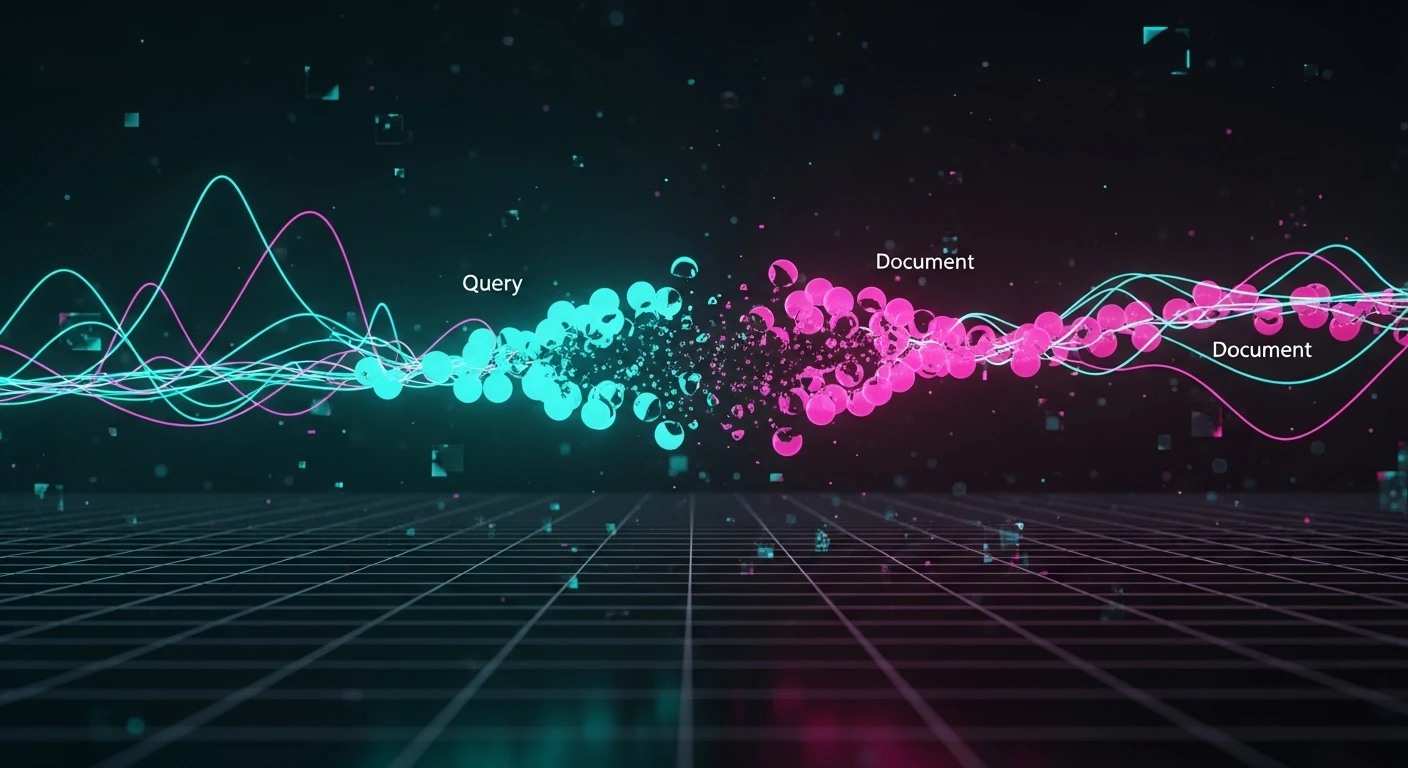
This is the embedding versioning problem: the vectors in your index were generated by Model Version A, but new queries are being embedded by Model Version B. The two versions produce vectors in subtly different spaces. Cosine similarity between them produces meaningless results because the models no longer agree on what "similar" means.
Why This Is Architecturally Different From Model Migration
Traditional model migration patterns assume you control the deployment timeline. You test the new model, validate outputs, and cut over when ready. Embedding model versioning violates this assumption in three ways:
You do not control the provider's release schedule. When you use hosted embedding APIs, the provider can update the underlying model without notice. Some providers version explicitly (OpenAI's text-embedding-3-small vs text-embedding-ada-002). Others update in place. Either way, the moment your query embeddings diverge from your index embeddings, retrieval quality degrades.
The failure mode is gradual, not catastrophic. A broken API throws errors. A version-mismatched embedding still returns vectors. Cosine similarity still computes. You get results — they are just wrong results. The system continues functioning while delivering degraded quality that may take days or weeks to surface through user complaints.
Re-indexing is expensive at scale. Your production vector store contains millions of embedded chunks. Re-embedding the entire corpus on every model update costs thousands of dollars in API calls and requires hours of pipeline time. You cannot casually rebuild your index every time a provider ships an update.
The Architecture of Version-Aware Embedding
Production RAG systems need embedding version awareness built into their infrastructure layer, not bolted on after the first incident:
Version-tagged vector stores. Every vector in your index should carry metadata indicating which embedding model version produced it. This means storing the model identifier (e.g., text-embedding-3-small-2024-01-25) alongside the vector itself. When you query, you can verify that your query embedding was produced by the same model version as the index vectors.
Embedding model pinning. Never use a provider's latest endpoint for production embeddings. Pin to specific model versions in your configuration. Treat embedding model versions with the same rigor you treat prompt versions — they are production dependencies that must be explicitly managed.
Dual-index migration strategy. When you must upgrade embedding models, maintain two indexes simultaneously: the existing index (with old embeddings) and a new index being incrementally populated with new embeddings. Route queries to both, compare results, and cut over only when the new index reaches full coverage and quality parity.
Detecting Version Drift in Production
The most dangerous aspect of embedding version mismatch is that standard observability approaches do not catch it. Your latency metrics stay green. Your throughput metrics stay green. Your error rates stay at zero. Everything looks healthy while retrieval quality silently degrades.
Detection requires embedding-specific monitoring:
Retrieval relevance scoring. Sample production queries, retrieve top-K results, and run an LLM-as-judge evaluation on relevance. Track this score over time. A sudden drop without corresponding code changes signals embedding version drift. This connects directly to eval-driven development principles — your retrieval layer needs continuous evaluation, not just your generation layer.
Embedding space consistency checks. Periodically re-embed a fixed set of reference documents and compare their vectors against the stored versions. If the cosine similarity between old and new embeddings of the same document drops below a threshold, the model has changed underneath you.
Provider version polling. For providers that expose model version metadata in API responses, log and monitor the version string. Alert when it changes. This gives you advance warning before quality degradation reaches users.
The Re-Indexing Pipeline
When drift is detected, you need a re-indexing pipeline that does not require downtime:
Incremental re-embedding with priority queues. Not all documents are equally important. Start re-embedding your most-queried documents first (identified from query logs), then work through the long tail. This restores quality for the majority of queries quickly while the full re-index completes in the background.
Shadow scoring during migration. While running dual indexes, score retrieval results from both and log the deltas. This gives you quantitative evidence of whether the new embeddings actually improve retrieval or just change it. Not every model update is an improvement for your specific corpus.
Atomic index swaps. Once the new index is fully populated and validated, swap the query routing atomically. Use the same feature flag patterns you apply to model rollouts — canary a percentage of traffic to the new index, monitor quality metrics, and roll forward or back based on data.
Cost Engineering the Versioning Problem
Re-embedding millions of documents is expensive. A corpus of 10 million chunks at $0.00002 per token (1000 tokens average per chunk) costs $200 per full re-index. At enterprise scale with 100 million chunks, that is $2,000 per re-index — and if your provider updates quarterly, that is $8,000 per year just on re-embedding costs.
Strategies to manage this:
Selective re-indexing based on query coverage. Analyze which documents actually get retrieved. In most production RAG systems, 20% of documents serve 80% of queries. Re-embed the high-traffic documents immediately; schedule the rest as background work.
Self-hosted embedding models for stability. Running your own embedding model (sentence-transformers, BGE, E5) eliminates the provider version drift problem entirely. You control when updates happen. The trade-off is operational overhead of model serving — but for teams at scale, the stability guarantee often justifies the infrastructure investment.
Embedding caching with version awareness. Cache embeddings by content hash AND model version. When the model version changes, cache misses force re-embedding — but only for documents that actually get queried. Lazy re-indexing triggered by real traffic rather than proactive full re-indexes.
The Organizational Failure Mode
The deepest version of this problem is organizational, not technical. Embedding models sit in the infrastructure layer — owned by platform teams, not product teams. Product teams build RAG features. Platform teams manage embedding infrastructure. Neither team monitors the intersection: the quality relationship between query embeddings and index embeddings.
This organizational gap means embedding version drift lives in nobody's OKRs. The platform team's SLA covers uptime and latency, not semantic consistency. The product team assumes the platform "just works." The gap between these assumptions is where retrieval quality goes to die.
The fix is ownership clarity: whoever owns the RAG pipeline owns the embedding version contract. That means monitoring, alerting, migration runbooks, and budget for periodic re-indexing. Without explicit ownership, embedding versioning remains the silent failure mode that teams discover only through user-facing quality incidents — and by then, the damage to user trust is already done.
Founder & Principal Architect
Ready to explore AI for your organization?
Schedule a free consultation to discuss your AI goals and challenges.
Book Free Consultation