The Fan-Out Amplification Problem in Multi-Agent Retrieval: Why One User Query Quietly Becomes a Thousand Backend Calls
A user asks your multi-agent system one question. Behind the scenes, a planner spawns sub-agents, each sub-agent issues its own retrieval calls, each retrieval hits several tools, and each tool fans out again. One innocent query becomes a thousand backend requests -- and your cost, latency, and blast radius scale with a number nobody is watching. Fan-out amplification is the silent tax that turns elegant agent architectures into unpredictable, expensive, fragile systems.
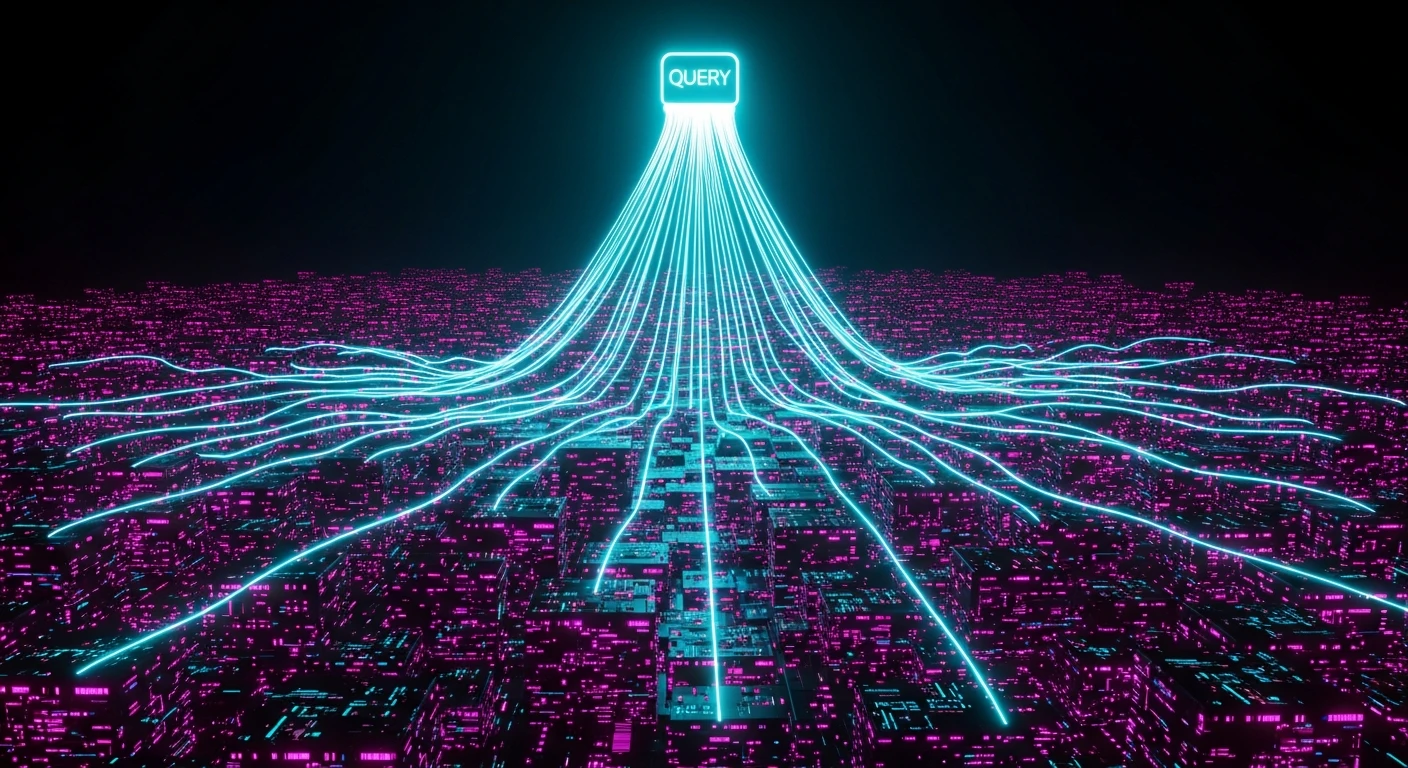
One Question In, A Thousand Calls Out
Here is a load profile that surprises nearly every team the first time they instrument it honestly. A user sends a single question to a multi-agent system. The orchestrator decides the question needs a plan, so it calls the model once to decompose it into five sub-tasks. It spawns five sub-agents. Each sub-agent, being autonomous, decides it needs context, so each fires three retrieval queries. Each retrieval query hits a hybrid search that queries a vector store and a keyword index and a reranker -- three backend calls apiece. Several sub-agents then decide to call a tool, and some tools are themselves agents that fan out again.
Do the arithmetic and one user request has become somewhere north of a hundred backend operations before anyone writes an answer. Add a retry policy and it is several hundred. Add a second conversational turn that re-runs retrieval over a growing context and you are in the thousands. None of this appears in the place teams look. The user sees one request. The frontend logs one request. The bill, the latency tail, and the dependency load all reflect a number that lives only in the call graph nobody drew.
This is fan-out amplification: the multiplicative explosion of backend work generated by the nested, autonomous structure of agentic systems. It is not a bug in any single component. Every layer is behaving reasonably. The amplification is an emergent property of composition, and it is the single most underestimated scaling risk in production multi-agent architectures.
Why Agentic Systems Amplify by Default
Traditional request handling is mostly additive. A request does a bounded set of things, and you can read the cost off the code path. Agentic systems are multiplicative because autonomy composes. Each layer makes its own independent decision about how much work to do, and those decisions multiply rather than add. A planner that expands into five sub-agents, each of which expands into four retrievals, each of which expands into three backend calls, produces sixty operations from a structure that looks, at each level, entirely modest.
The reason this stays invisible is that no single layer sees the total. The sub-agent that fires four retrievals thinks it is being thorough, not expensive. It has no idea it is one of five siblings, or that its parent was itself one of several branches. Amplification is a global property of a system built from locally reasonable actors, which is precisely why it evades local code review. You cannot find it by reading any one function. You find it only by tracing a real request end to end -- which is why distributed tracing across multi-agent systems is not a nicety but the only instrument that can see the true call graph.
The Three Costs That Scale With Fan-Out
Fan-out does not just cost money. It scales three distinct things at once, and each fails differently.
Spend. Every fanned-out model call and every retrieval has a price. A system whose average request touches two hundred billable operations has an economic profile completely divorced from the one-request mental model its operators carry. Worse, the amplification factor is variable -- a hard query fans out more than an easy one -- so your cost per request has a long, unpredictable tail. This is the same dynamic that makes cost attribution in multi-agent systems genuinely hard: the spend belongs to a call tree, not a line item, and without per-branch accounting you cannot even say which part of the tree is bleeding you.
Latency. Fan-out that runs sequentially blows your latency budget; fan-out that runs in parallel blows your concurrency limits. Teams usually parallelize to protect latency, which trades a time problem for a load problem -- a hundred simultaneous retrievals against a store sized for ten. The tail latency of the slowest branch becomes the latency of the whole request, so amplification makes your p99 hostage to your unluckiest sub-agent.
Blast radius. This is the one that turns a slowdown into an outage. When a downstream dependency degrades, an amplified system does not send it one extra request -- it sends it the full fan-out multiple, all at once, from every in-flight user request simultaneously. The system attacks its own struggling dependency with its full amplification factor, which is exactly the mechanism behind retry-storm and thundering-herd cascades in agent fleets. Fan-out is the amplifier that makes those cascades catastrophic instead of merely annoying.
Why It Passes Every Test and Then Falls Over
In development, fan-out is invisible because you test with one request at a time. A single query fanning out to two hundred operations completes in a couple of seconds against unloaded dependencies, and everything looks fine. The amplification only bites under concurrency, when a hundred users each generate their own fan-out and the products collide against shared backends.
This is the classic gap between the system you evaluated and the system you deployed. Your eval harness fired queries serially and measured quality; it never measured what happens when the fan-out of many requests overlaps in time. Closing that gap is exactly the argument for eval-driven development that tests the system under realistic concurrent load, not just single-shot correctness. An agent architecture that is correct per-request and ruinous in aggregate has passed the wrong test.
The deeper failure is that fan-out is an undeclared dependency between layers. The planner does not know or bound how much work its children will generate; the children do not know how many siblings they have. There is no contract governing the total. This is the same class of problem that data contracts for AI pipelines exist to solve: make the implicit budget explicit, so that a component that intends to fan out a hundredfold has to say so, and a parent that cannot afford it can refuse.
Engineering Fan-Out Under Control
The goal is not to eliminate fan-out -- it is often what makes multi-agent systems powerful -- but to bound it and see it.
Propagate a fan-out budget. Pass a work budget down the call tree the way you would pass a deadline. The planner gets a budget of, say, a hundred operations; it allocates portions to each sub-agent; a sub-agent that would exceed its allocation must degrade -- fewer retrievals, cheaper models -- rather than expand freely. Budget propagation converts uncontrolled multiplication into a bounded, allocable resource.
Make the call graph a first-class artifact. Emit a trace for every request that shows the full tree: which layer spawned what, how many operations each branch produced, and the amplification factor for the request as a whole. If you cannot pull up the fan-out factor for last hour's traffic, you are flying blind on your single biggest cost and load driver.
Cache aggressively across siblings. Amplification is full of redundancy -- five sub-agents often retrieve overlapping context. Request-scoped caching and request coalescing so identical in-flight calls share one result can collapse a large fraction of the fan-out at near-zero quality cost.
Bound depth and breadth explicitly. Cap how many sub-agents a planner may spawn and how deep the nesting may go. Unbounded recursion in an agent graph is the fan-out equivalent of a fork bomb; a hard depth-and-breadth limit is cheap insurance against the pathological cases.
Isolate fan-out-heavy paths. Put the amplifying operations behind their own resource pools and bulkhead isolation so a fan-out spike in one workflow cannot exhaust the shared pool every other request depends on.
The Number Nobody Owns
The reason fan-out amplification persists is organizational as much as technical: no one owns the total. The team building the planner optimizes the planner. The team building retrieval optimizes retrieval. The amplification factor -- the product of all their local decisions -- belongs to no one, appears on no dashboard, and surfaces only as a mysterious bill, a bad p99, or a 2 a.m. outage when a dependency wobbles.
Elite AI teams treat the amplification factor as a named, owned, monitored metric -- the same way mature systems treat error budgets. They know the average and tail fan-out of their traffic, they alert when it drifts, and they design every new agent with a budget it must live within. That discipline is the difference between a multi-agent architecture that scales gracefully and one that works beautifully in the demo and collapses under its own composition in production.
This is the kind of systems thinking that separates production AI engineering from prototype assembly. If your multi-agent system is elegant per-request and unpredictable in aggregate, the fan-out is where the truth is hiding.
Building multi-agent systems that need to survive real concurrency? Book a working session with Bigyan Analytics and we will map your fan-out before it maps your outage.
Founder & Principal Architect
Ready to explore AI for your organization?
Schedule a free consultation to discuss your AI goals and challenges.
Book Free Consultation