The Idempotency Gap in Agentic Tool Calls: Why Retried Actions Silently Double-Execute in Production
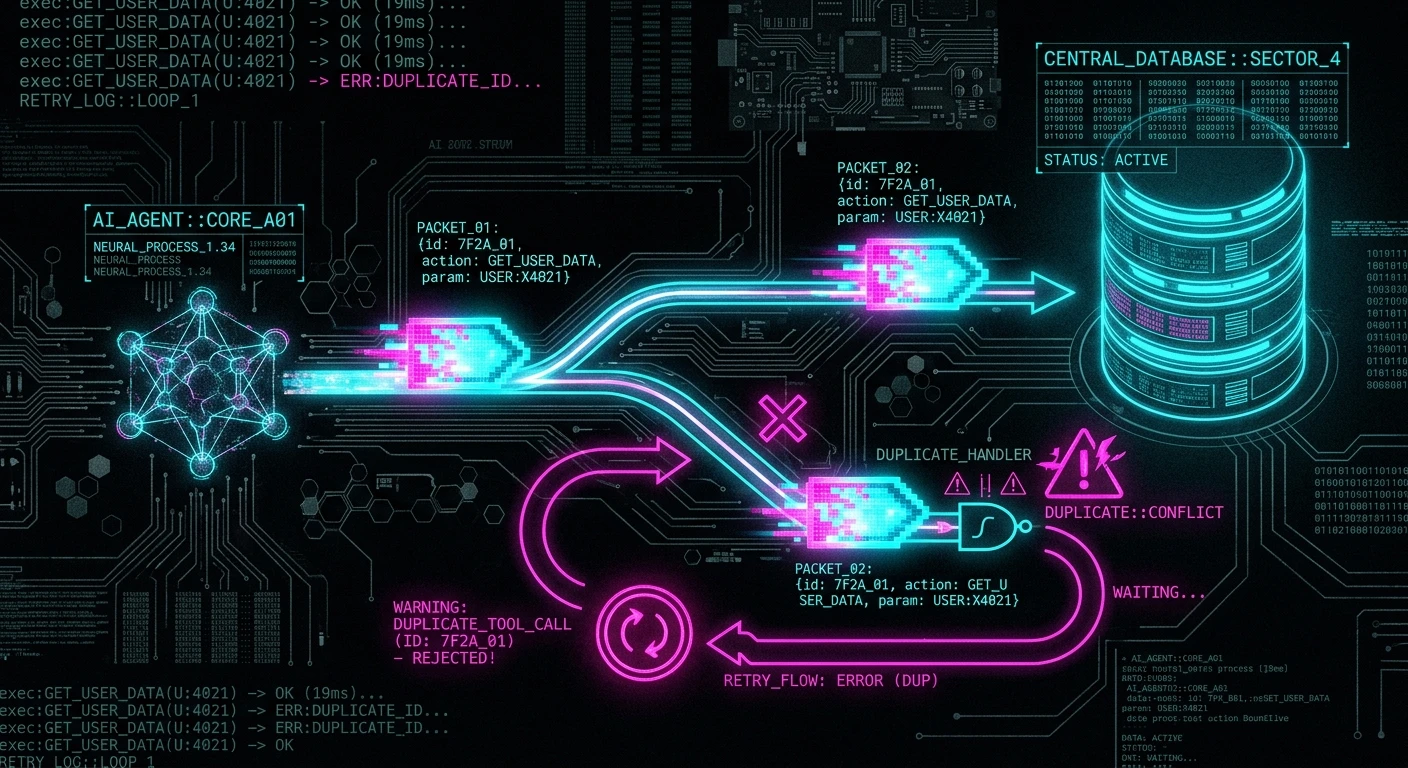
Your agent framework retries a failed tool call the way any resilient system should -- timeout, back off, try again. But the first attempt did not fail; it succeeded and the acknowledgment got lost. Now the payment ran twice, the ticket opened twice, the email sent twice. The idempotency gap is the seam where ordinary retry logic collides with agents that take real actions on the world, and it turns your reliability feature into a duplication engine.
The Retry That Ran Twice
Here is a failure that looks like reliability engineering and behaves like sabotage. Your agent calls a tool. The call takes too long, the client hits its timeout, and the framework does the responsible thing: it retries. Back off, try again, degrade gracefully. Every distributed-systems instinct you have says this is correct.
Except the first call did not fail. It reached the downstream system, executed, and committed. What failed was the acknowledgment on the way back -- a dropped connection, a slow response, a load balancer that gave up. The action succeeded; only the confirmation was lost. So your retry does not recover a failed operation. It performs a second, identical one. The refund is issued twice. The support ticket is created twice. The outbound email goes to the customer twice. The idempotency gap is the seam where standard retry logic meets an agent that acts on the real world, and it quietly converts your safety mechanism into a duplication engine.
This is not an exotic edge case. It is the default behavior of nearly every agent framework in production today, because those frameworks inherited retry semantics from a world of read-mostly API calls and never adapted them for tools that mutate state irreversibly.
Why Agents Make This Worse Than Classic Retries
Retries are old. Idempotency keys are old. The banking and payments world solved the double-charge problem decades ago. So why does this resurface as a fresh crisis in agentic systems? Because agents break every assumption the classic solution relied on.
The caller does not know which calls mutate state. In a hand-written integration, an engineer knows that GET is safe to retry and POST is not. An agent selecting tools at runtime has no such discipline. It sees a tool named submit_order and a tool named check_status as interchangeable capabilities, and the retry layer beneath it treats them identically. The knowledge that would prevent a dangerous retry lives in a human's head, and the human is no longer in the loop.
Tool calls are generated, not written. The arguments to a tool call are produced by a model, which means the same logical action can be expressed with slightly different payloads across attempts. If your deduplication depends on exact-match request bodies, a regenerated retry with a reworded field slips right past it. This is the operational cousin of the schema evolution trap, where a small change in a tool's output format breaks agents that were working yesterday -- except here the instability is on the input side and it defeats your dedup logic.
Multi-agent pipelines multiply the retry surface. In a chain of agents, a retry can fire at any layer -- the orchestrator retries the sub-agent, the sub-agent retries the tool, the tool's client library retries the HTTP call. A single logical action can be attempted three times across three layers, none of which knows the others are also retrying. This is the context handoff tax compounded into an execution tax, where every boundary between agents adds a failure mode nobody owns.
The blast radius is the real world. A duplicated read costs you nothing. A duplicated write costs you a double charge, a duplicate shipment, a customer who got paged twice at 3 a.m. Agents are increasingly wired to side-effecting tools -- payments, provisioning, communications -- which means the cost of a silent double-execute is no longer a stale cache. It is an irreversible action, and it connects directly to the rollback illusion, where reverting the model does nothing about the actions the agent already took.
Why You Will Not See It in Testing
The idempotency gap is nearly invisible in development, which is why it ships. In testing, your network is fast and reliable, timeouts rarely fire, and when they do the retry usually lands after a genuine failure. The precise race condition that causes double-execution -- success on the server, lost acknowledgment on the wire, retry on the client -- requires production-grade latency, load, and flakiness to reproduce with any frequency.
Worse, the duplicated action often succeeds. The second refund goes through cleanly. There is no error, no exception, no red line in the dashboard. From the system's point of view, two successful operations occurred. The only evidence is downstream: a reconciliation report that does not balance, a customer complaint, an accountant's question. By then the action is committed and days old. This is the definition of a silent failure in agentic systems, where success metrics look green while the system does the wrong thing.
Engineering the Gap Closed
Closing the idempotency gap is not about disabling retries -- you need them. It is about making every state-mutating action safe to attempt more than once. Four disciplines matter.
Idempotency keys, generated once, upstream of the retry. Every side-effecting tool call must carry a unique idempotency key that is generated at the point the action is decided, not at the point it is transmitted. The key must survive across retries so all attempts share it. The downstream system uses it to recognize a repeat and return the original result instead of executing again. Critically, the key cannot be derived from the model-generated payload, which varies -- it must be assigned by the orchestration layer as a stable identity for the logical action.
Classify tools by their side-effect semantics. Your tool registry should declare, for every tool, whether it is safe to retry, requires an idempotency key, or must never be automatically retried at all. The retry layer reads this classification and behaves accordingly. Treating all tools as uniformly retryable is the root error. This is the same rigor as enforcing contract testing across AI agent integrations, where the guarantees each side makes are explicit and verified.
Put retry decisions in a deterministic control plane, not the model. The model should decide what action to take. Whether and how to retry that action is an infrastructure decision that must live in deterministic code with full knowledge of side-effect semantics -- never delegated to the probabilistic layer. This separation is the core argument for deterministic control planes around agentic AI, where the non-negotiable safety logic is code, not prompt.
Make duplicates observable before they become incidents. Even with keys and classification, you need to detect duplication in flight. Emit a decision-scoped record for every action attempt with its idempotency key, and alarm when the same logical action is attempted across layers. Without this, your first signal is the reconciliation report -- which is to say, an observability gap, where you cannot see what your AI system is actually doing until the damage is done.
The Position
Retry logic built for stateless reads has no business governing state-mutating agent actions, and yet it is the default in most frameworks shipping today. The idempotency gap is not a bug in your code -- it is an architectural mismatch between the reliability patterns you inherited and the fact that your agents now act on the world with real, irreversible consequences.
The fix is not clever. It is idempotency keys assigned upstream, tools classified by side-effect, retry decisions in deterministic code, and duplication made observable. What is hard is admitting that resilient retries and safe actions are not the same property, and that you have been conflating them since the day your agent first touched a system it could not undo.
Build Agentic Systems That Do Not Double-Execute
Bigyan Analytics designs production agentic architectures where reliability and safety are engineered together, not traded against each other. If your agents take real actions on real systems, book a working session and we will pressure-test your retry and idempotency posture before production does it for you.
Founder & Principal Architect
Ready to explore AI for your organization?
Schedule a free consultation to discuss your AI goals and challenges.
Book Free Consultation