The LLM-Maintained Knowledge Base: Why Development and Product Teams Should Stop Writing Wikis
Traditional wikis die because humans abandon them. The fix is not better discipline — it is removing humans from the maintenance loop entirely. LLMs can incrementally build and maintain a persistent knowledge base that stays current, cross-referenced, and actually useful.
Every Wiki You Have Ever Built Is Dead
Let me describe a pattern that has played out at every engineering organization I have worked with. Someone — usually a well-intentioned tech lead or PM — creates a wiki. It starts strong. Architecture decisions get documented. Onboarding guides get written. Meeting notes get filed. For about six weeks, the wiki is alive.
Then it starts dying. An architecture decision changes but nobody updates the page. A new engineer writes a second onboarding guide because they could not find the first one. Meeting notes stop getting filed because the person who was filing them switched teams. Cross-references break. Pages contradict each other. Within six months, the wiki is a graveyard of half-truths that nobody trusts and everyone ignores.
This is not a discipline problem. This is a fundamental incentive problem. Maintaining documentation has negative immediate value — it costs time now and benefits someone else later. No amount of "documentation culture" fixes this because you are fighting basic human psychology. The person who knows the information has zero incentive to spend 30 minutes writing it down when they could be shipping code.
The conventional solution has been to throw more process at it. Documentation sprints. Wiki gardening rotations. "Definition of done includes docs." These are band-aids on an arterial wound. They work for exactly as long as someone is actively enforcing them, and they collapse the moment that person gets busy with something else.
There is a better architecture. And it does not involve humans writing wikis at all.
The Pattern: LLM-Maintained Knowledge Bases
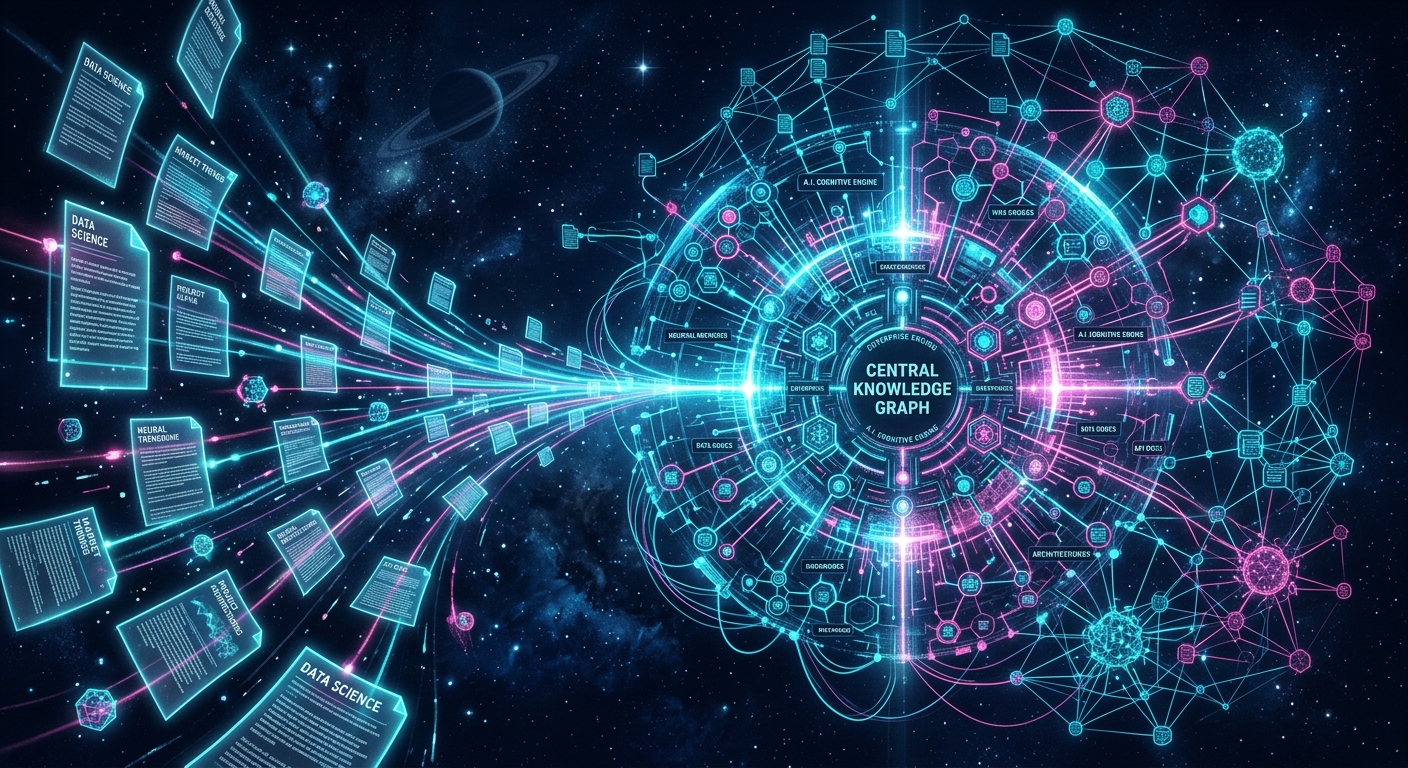
The emerging pattern that actually solves this problem is structurally different from both traditional wikis and the now-standard RAG approach. Instead of uploading documents and retrieving chunks at query time, you have an LLM incrementally build and maintain a persistent knowledge base — a structured, interlinked set of pages that sits between you and your raw sources.
When new information arrives — a sprint retro transcript, an architecture decision record, a customer call recording, a post-mortem — the LLM reads it, extracts the key information, integrates it into existing pages, updates cross-references, notes contradictions with prior knowledge, and strengthens the overall synthesis. Knowledge is compiled once and kept current, not re-derived on every query.
This is not RAG. RAG retrieves and generates on every question. This pattern compiles knowledge ahead of time and keeps the compilation current. The distinction matters enormously for quality, cost, and reliability.
Think of it as the difference between an interpreter and a compiler. RAG interprets your knowledge base on every query — fetching chunks, hoping the right ones surface, synthesizing on the fly. The LLM-maintained knowledge base compiles your knowledge into a structured, navigable artifact that can be read by humans and machines alike. The compilation cost is paid once. Queries against compiled knowledge are fast, cheap, and reliable.
The Three-Layer Architecture
The architecture has three distinct layers, and understanding the separation is critical to making it work.
Layer 1: Raw Sources
These are your immutable source documents. Sprint retro transcripts. Slack threads. Meeting recordings and their transcripts. Pull request descriptions and code review comments. Architecture Decision Records. Customer call transcripts. Incident post-mortems. Product requirements documents. Competitor analysis reports.
Raw sources are append-only. You never modify them. They are the ground truth that the knowledge base is built from. Everything in the wiki should be traceable back to one or more raw sources.
Layer 2: The Wiki
This is the LLM-generated and LLM-maintained knowledge base. It consists of markdown pages organized by type:
Entity pages. One page per important entity — a service, a team, a customer segment, a product feature. The page contains everything the organization knows about that entity, synthesized from all raw sources that mention it. Cross-references link to related entities.
Concept pages. Pages that explain how things work — architecture patterns, business processes, decision frameworks. These are the pages that new team members actually need to read.
Summary pages. Rolling summaries of recurring events — weekly sprint outcomes, monthly customer feedback themes, quarterly roadmap shifts. These replace the "what happened last quarter" meetings that consume hours of senior leadership time.
Comparison pages. Side-by-side analyses that the LLM generates when it detects related but distinct concepts — comparing two architectural approaches, two vendor options, two customer segments. These are the pages that humans almost never write but desperately need.
Decision log pages. A living record of key decisions, their rationale, who made them, and what has changed since. This is the institutional memory that walks out the door when a senior engineer leaves.
The LLM owns this layer entirely. Humans read it but do not write it. This is the key insight — removing humans from the write path is what makes the system sustainable.
Layer 3: The Schema
This is a configuration document — think of it as the LLM's editorial guidelines. It tells the LLM how the wiki is structured, what conventions to follow, what page types exist, how cross-references work, and what workflows to execute when new information arrives.
The schema is the one artifact that humans must maintain, and it is small — typically a single document of 50 to 100 lines. It is the leverage point: by editing the schema, you change how the LLM organizes and maintains the entire knowledge base.
A good schema specifies: the directory structure of the wiki, the template for each page type, the cross-referencing conventions, the rules for when to create a new page versus update an existing one, and the priority order for resolving contradictions between sources.
The Three Core Workflows
The knowledge base operates through three distinct workflows, each triggered differently.
Ingest
When a new raw source arrives, the LLM executes an ingest workflow. It reads the new source, identifies the key information, determines which existing wiki pages are affected, and updates them. A single source document typically triggers updates to 10 to 15 wiki pages.
For example, when a post-mortem document is ingested: the LLM updates the entity page for the affected service with the incident details. It updates the concept page for the relevant architecture pattern with the lessons learned. It adds an entry to the decision log if architectural changes were decided. It updates the summary page for the current quarter's incidents. It creates or updates comparison pages if the incident revealed differences between how two services handle the same failure mode.
The ingest workflow is where the real value is created. Every piece of information is immediately contextualized against everything the organization already knows. This is the work that humans refuse to do — not because they cannot, but because the effort of finding all related pages, reading them, synthesizing the new information, and updating cross-references is simply too expensive in human attention.
Query
When someone needs information, they query the wiki. At small scale — under a few hundred pages — this is as simple as searching an index page or using keyword search across markdown files. At larger scale, you layer in BM25 and vector search over the wiki pages.
The critical difference from RAG: the query is searching pre-synthesized, structured pages — not raw document chunks. The answer quality is dramatically better because the synthesis work has already been done. The LLM answering the query is reading a well-organized wiki page, not trying to make sense of five semi-relevant document fragments.
If the query produces a novel synthesis — combining information from multiple wiki pages in a way that seems generally useful — the answer itself gets filed back into the wiki as a new page. The knowledge base grows through use.
Lint
Periodically — daily or weekly depending on the rate of change — the LLM runs a lint workflow across the entire wiki. This is a health check that identifies:
Contradictions. Page A says the authentication service uses JWT tokens. Page B says it uses session cookies. The lint flags this for human review or, if the schema specifies resolution rules, resolves it automatically by checking which source is more recent.
Stale claims. Information that references dates, versions, or states that may have changed. "We are currently evaluating vendor X" written three months ago probably needs an update.
Orphan pages. Pages that no other page links to, suggesting they may be irrelevant or poorly integrated.
Missing cross-references. Pages that discuss related concepts but do not link to each other.
Coverage gaps. Entity pages that are suspiciously thin compared to how frequently the entity appears in raw sources, suggesting the ingest workflow missed something.
The lint workflow is what keeps the knowledge base alive long-term. It is the automated equivalent of the "wiki gardener" role that organizations try to create and that always fails because no human wants to do it.
Why Development Teams Need This
For engineering teams specifically, this pattern solves three problems that have plagued software organizations since the first internal wiki was created.
The Onboarding Problem
Every engineering team has institutional knowledge that lives in people's heads. How the deployment pipeline actually works (not how the docs say it works). Why that one service has a weird retry configuration. What happened in the Great Database Migration of 2024 and why certain decisions were made. Which parts of the codebase are load-bearing and which are technical debt scheduled for removal.
New engineers learn this through an expensive, slow process of asking questions, getting partial answers, and gradually building a mental model. The LLM-maintained knowledge base compiles this institutional knowledge continuously. New engineers read the wiki. The wiki is current because the LLM updates it after every sprint retro, every architecture decision, every incident. The knowledge that used to take six months to acquire through osmosis is available on day one.
The Context Switching Problem
When an engineer picks up a ticket for a service they have not touched in three months, they need to rebuild context. What changed? Were there incidents? Did the API contract shift? In most organizations, this context rebuild involves reading Slack history, checking recent PRs, and asking colleagues. It takes hours.
With a maintained knowledge base, the service's entity page has the current state. The decision log has what changed and why. The summary page has recent incidents and their resolutions. Context rebuild goes from hours to minutes.
The Knowledge Loss Problem
When a senior engineer leaves, their institutional knowledge leaves with them. The LLM-maintained knowledge base captures this knowledge continuously — not through exit interviews or documentation sprints, but through the normal course of work. Every post-mortem they write, every architecture decision they participate in, every code review comment they leave gets ingested and compiled into the knowledge base. The knowledge persists because it was captured incrementally, not in a panic during someone's notice period.
This connects directly to how we think about memory architecture for enterprise AI agents. The knowledge base is a form of organizational memory — persistent, structured, and continuously updated. It solves the same problem at the team level that memory architecture solves at the agent level.
Why Product Teams Need This Even More
If engineering teams benefit from maintained knowledge bases, product teams benefit even more — because the synthesis burden on product managers is enormous and almost entirely manual today.
The Customer Intelligence Problem
A product manager at a mid-size SaaS company might conduct or review 200 customer calls per year. Each call contains insights about pain points, feature requests, competitive positioning, and usage patterns. Today, those insights live in scattered notes, half-filled CRM fields, and the PM's memory.
With an LLM-maintained knowledge base, every customer call transcript gets ingested. The LLM updates the customer segment pages with new pain points. It updates feature request pages with frequency counts and verbatim quotes. It updates competitive comparison pages when customers mention alternatives. Before a roadmap review, the PM reads the wiki — the synthesis is already done, updated after every single call.
This is the same transformation that is happening in qualitative research — the shift from manual synthesis to continuous, automated knowledge compilation. The difference is that product teams can apply it to their own operational data, not just formal research studies. Teams that build research repositories people actually use are already moving in this direction; the LLM-maintained knowledge base is the logical endpoint.
The Strategic Context Problem
Product decisions require synthesizing information from multiple domains — customer feedback, market trends, engineering constraints, business metrics, competitive intelligence. Today, this synthesis happens in a PM's head, which means it is limited by one person's ability to hold context, biased by recency, and lost when the PM changes roles.
The knowledge base maintains this synthesis persistently. The competitive landscape page is updated when new market research arrives. The engineering constraints page is updated after every architecture review. The business metrics page is updated from quarterly reports. The PM's job shifts from synthesis (which the LLM does better at scale) to judgment (which humans do better with good information).
Implementation: Simpler Than You Think
The technical implementation is deliberately low-tech. This is not an infrastructure project — it is a workflow project.
LLM. Any capable coding agent works — Claude Code, Codex, or similar tools that can read files, write files, and follow complex instructions. The agent needs to be able to read a source document, read existing wiki pages, and write updated wiki pages. That is it.
Storage. Plain markdown files in a git repository. This gives you version control for free — every wiki update is a commit, every change is diffable, and you can revert if the LLM makes a mistake. Obsidian or any markdown editor works as a reading interface. For teams already using git, the barrier to entry is essentially zero.
Search. At small scale (under 500 pages), an index.md file that the LLM maintains — essentially a table of contents with descriptions — is sufficient. The LLM reads the index, identifies relevant pages, and reads those. At larger scale, layer BM25 (keyword search) and vector search over the markdown files. Tools like Elasticsearch or even simple full-text search handle this well.
Orchestration. A simple script or CI hook that triggers the ingest workflow when new source documents arrive. This can be a cron job that watches a directory, a Slack bot that processes messages from specific channels, or a webhook from your meeting transcription service. For the multi-agent pattern, the knowledge base maintenance can be one agent in a larger orchestration — the "librarian" agent that other agents consult and that continuously processes new information.
The schema document is the most important piece to get right, and it is the one that requires human judgment. A good schema for an engineering team might specify: entity pages for every service, library, and external dependency. Concept pages for architecture patterns, deployment procedures, and debugging playbooks. Decision logs organized by quarter. Summary pages for sprint retros and incident trends.
The Curation Question
Let me be direct about the limitation: this is not a fully autonomous system. The LLM maintains the wiki, but humans must curate the schema, review the lint results, and occasionally correct the LLM's synthesis.
The schema requires thoughtful design. A bad schema produces a knowledge base that is either too granular (thousands of tiny pages with no useful synthesis) or too coarse (a few massive pages that are hard to navigate). Getting the right level of abstraction — the right page types, the right granularity, the right cross-referencing conventions — requires someone who understands what the team actually needs to know.
The lint results require human judgment. When the LLM flags a contradiction, someone needs to decide which version is correct. When it identifies a coverage gap, someone needs to decide whether the gap matters. The lint workflow reduces the maintenance burden by orders of magnitude, but it does not eliminate human oversight entirely.
And the LLM will occasionally get things wrong. It will misinterpret a source document. It will create a cross-reference that does not make sense. It will merge two concepts that should be separate. The git-based storage makes these errors easy to catch and revert, but someone needs to be reading the wiki and filing corrections.
The difference from traditional wikis: the human effort shifts from writing and maintaining (high effort, low motivation, everyone's job and therefore nobody's job) to reviewing and correcting (low effort, high leverage, can be assigned to a specific person). Instead of asking twenty engineers to document their work, you ask one person to spend an hour a week reviewing the LLM's output. That is a sustainable workflow.
RAG Is Not Dead — But It Is Not Enough
I want to be precise about the relationship between this pattern and traditional RAG, because the nuance matters.
RAG remains the right architecture for querying large, relatively static document collections where pre-synthesis is impractical or unnecessary. If you have 10 million legal documents and need to find relevant precedents for a specific case, RAG is the right tool. You do not want to pre-synthesize 10 million documents into a wiki.
The LLM-maintained knowledge base is the right architecture for operational knowledge — the living, evolving body of information that a team generates through its daily work and needs to access in synthesized form. Sprint retros, architecture decisions, customer calls, incident reports, competitive intelligence — this is knowledge that benefits enormously from continuous synthesis because the value is in the connections between pieces of information, not in any individual document.
The two patterns are complementary. You might use RAG to query your codebase and documentation, while the LLM-maintained knowledge base handles the operational knowledge that sits above the code. The knowledge base can even reference RAG results — "for the implementation details, see the codebase" — while maintaining the higher-level synthesis that RAG alone cannot provide.
The Wiki Is Dead. Long Live the Wiki.
The traditional wiki failed because it required humans to do work that humans are bad at: continuous, low-glory maintenance of shared knowledge. Every wiki tool, every documentation platform, every knowledge management system has tried to solve this with better UX, better templates, better integrations. None of it worked because the core problem was never the tooling — it was the maintenance incentive.
LLMs solve the maintenance problem. They do not get bored. They do not switch teams. They do not decide that updating the architecture diagram is less important than shipping a feature. They process every source document with the same diligence whether it is January or December, whether the team is in crunch mode or not.
The result is a knowledge base that actually stays current — not because anyone is disciplined enough to maintain it, but because the maintenance is automated. The humans do what humans are good at: deciding what knowledge matters, how it should be organized, and whether the LLM's synthesis is correct. The LLM does what LLMs are good at: reading everything, connecting everything, and writing it all down.
Your team's next wiki should not be written by your team. It should be written by an LLM that reads everything your team produces and compiles it into knowledge that your team can actually use. The era of human-maintained wikis is over — not because the intent was wrong, but because the maintenance model was always doomed.
Bigyan helps engineering and product organizations design and implement LLM-maintained knowledge systems. From schema design to orchestration architecture, we build the knowledge infrastructure that stays alive after the initial enthusiasm fades. Talk to us about your team's knowledge problem.
Founder & Principal Architect
Ready to explore AI for your organization?
Schedule a free consultation to discuss your AI goals and challenges.
Book Free Consultation