The Partial Write Problem: Why AI Agents That Fail Mid-Action Leave Enterprise State Silently Corrupted
A traditional service that crashes mid-transaction rolls back and leaves your data clean. An AI agent that fails mid-action does the opposite: it has already updated the CRM, half-sent the email, and not yet logged the refund -- and there is no transaction wrapping any of it. The agent moves on, the run looks successful, and your enterprise state is now quietly, plausibly wrong. This is the partial write problem, and it is the failure mode that turns a flaky agent into a slow-motion data-integrity crisis.
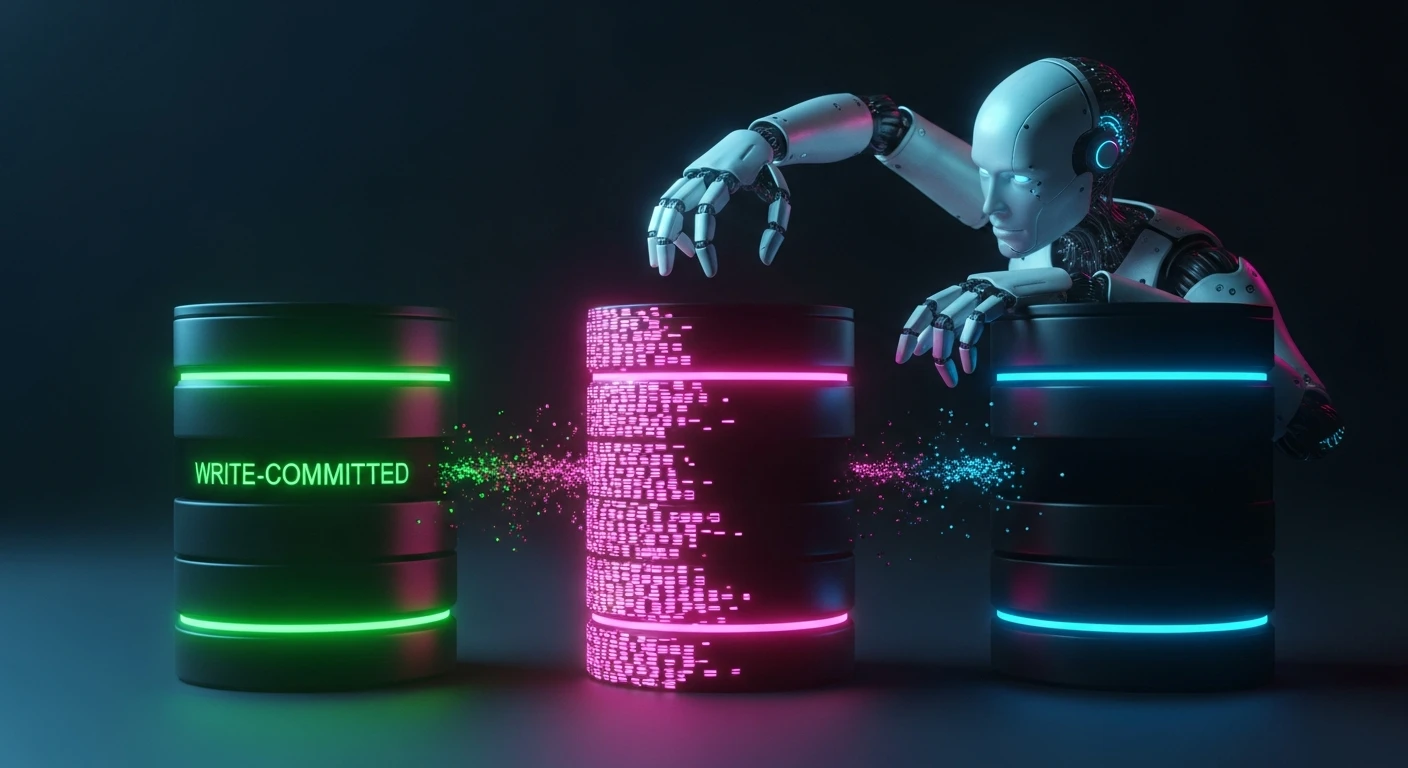
The Failure Mode Nobody Wrapped in a Transaction
When a traditional backend service dies in the middle of doing work, decades of database engineering have your back. The write was inside a transaction, the transaction did not commit, and the system rolls back to a clean state as if the failed operation never happened. Atomicity is not a feature you think about; it is the ground you stand on. You can build confidently on top of a service precisely because a half-done operation is not a state the system is allowed to be in.
Agentic systems tear that ground out from under you. An AI agent completing a task is not one transaction -- it is a sequence of independent side effects executed against systems that know nothing about each other. It updates a record in the CRM, calls the billing API to issue a refund, sends a confirmation email, and writes a note to the ticketing system. Four side effects, four systems, zero shared transaction. When the agent fails after step two, there is no rollback. The CRM is updated, the refund is issued, the email never went out, and the ticket still says open. Nothing crashed loudly. The run just ended, and your enterprise state is now internally inconsistent in a way no single system can detect.
This is the partial write problem, and it is structurally worse in agentic systems than anywhere else in software, because the agent is both the orchestrator and the thing that is unreliable. The very component responsible for completing the sequence is the component most likely to wander off, time out, or decide mid-plan that it is done.
Why Agents Make Partial Writes the Default, Not the Edge Case
In conventional software, partial writes across systems are a known hard problem that senior engineers design against deliberately -- with sagas, with outbox patterns, with reconciliation jobs. They are treated as the dangerous edge. In agentic systems they become the default, for three compounding reasons.
First, agents chain tool calls dynamically. The sequence of writes is not a fixed, reviewed code path; it is generated at runtime by a model reasoning its way through a task. There is no static guarantee that every write has a corresponding compensating action, because the plan did not exist until the agent invented it. This is the same class of hazard as tool schema drift, where the contract an agent relies on quietly changes underneath it -- except here the contract that is missing is the one that says these four writes belong together.
Second, agents fail non-deterministically and mid-stream. A deterministic pipeline either runs to completion or fails at a predictable point you can handle. An agent can fail because a model call timed out, because it hit a token limit, because it hallucinated that the task was complete, or because a downstream tool returned something it did not know how to parse. Every one of those failure points can land between two writes. The randomness is not incidental; it is intrinsic, and it compounds across a multi-step run the way a non-determinism budget compounds randomness through an agent stack.
Third, and most dangerously, the run often reports success anyway. The agent completed its final "I have finished the task" step even though a middle write silently failed, so your logs show a green run. The corruption is invisible at the point it happens and only surfaces days later when a human notices the refund with no email, or the reconciliation that will not balance. It is a textbook silent failure, where the agent's own success metric says everything is fine while the real-world outcome is broken.
The Corruption Is Plausible, Which Is What Makes It Expensive
A loud crash is cheap. It pages someone, it shows up in an error dashboard, and it gets fixed. The partial write is expensive precisely because the resulting state is plausible. The CRM record looks normal. The refund looks normal. Nothing is malformed -- the data is simply incomplete in a way that only makes sense if you know the full sequence that was supposed to run and can see that part of it did not.
This is why partial writes evade most monitoring. Observability tuned to catch errors and latency spikes sails right past a run where every individual call returned 200 and the only problem is that the run stopped after call two of four. Catching it requires monitoring the semantic completeness of the outcome, not the health of the individual calls -- the difference between watching for exceptions and building observability that actually understands what a correct end-state looks like. And when these half-completed operations feed downstream analytics or customer-facing reports, they propagate as confident, clean-looking data that no one thinks to question -- the enterprise-data version of a problem qualitative researchers know well, where a number that looks like ground truth was never actually validated against reality.
Engineering Agents That Cannot Corrupt State Halfway
You cannot make an agent's individual steps reliable -- non-determinism is the price of the capability. What you can do is refuse to let an unreliable orchestrator perform unguarded multi-system writes. The fix is architectural, and it borrows directly from how distributed systems have always survived partial failure.
- Separate deciding from doing. Let the agent produce a proposed plan of writes as structured data, then execute that plan through a deterministic control layer that owns the actual side effects. The model reasons; the control plane commits. This is the core discipline of a deterministic control plane wrapping non-deterministic agents, and it is what lets you wrap the writes in guarantees the model cannot provide.
- Make every write idempotent and reconciled. Each side effect should carry a stable operation ID so a retried step overwrites rather than duplicates, and a reconciliation job should continuously check that every started operation reached a terminal, complete state -- surfacing the half-done ones instead of trusting the run's self-reported success.
- Model multi-system tasks as sagas with explicit compensation. If step three fails, the system must know how to undo steps one and two, not leave them stranded. Every forward write needs a defined compensating action, so a failed sequence converges back to a clean state instead of a plausible-but-wrong one.
- Persist the intended plan before executing any of it. Write the full sequence of intended actions to durable storage first, so that after a crash a recovery process can compare intended against completed and finish or roll back the difference -- the agentic equivalent of an outbox that makes partial progress recoverable rather than lost.
- Verify the end-state, not the run status. Your success signal should be a check that the world matches the intended outcome -- refund issued AND email sent AND ticket closed -- not that the agent said it was done. Green runs are not the same as correct state.
The enterprises that get burned by agents are rarely burned by a dramatic failure. They are burned by a thousand quiet partial writes that each looked successful and collectively rotted their data integrity until someone downstream stopped trusting the system. The teams that ship agents to production safely are the ones that stopped treating the agent as a transactional actor and started treating it as an unreliable planner sitting behind a control plane that actually owns the writes. Atomicity was never optional. Agentic architectures just made you responsible for building it yourself.
Founder & Principal Architect
Ready to explore AI for your organization?
Schedule a free consultation to discuss your AI goals and challenges.
Book Free Consultation