The Retry Storm Amplification Problem: Why Your Agent's Backup Requests Turn a Slow Tool Into a Full Outage
One tool gets slow, so your agent retries. Every other agent instance retries too. The hedged requests you added for resilience become a self-inflicted DDoS against your own backend, and a recoverable slowdown collapses into a total outage -- amplified by the exact retry logic you deployed to prevent it. Retry storm amplification is how well-intentioned resilience patterns invert into the failure they were meant to stop.
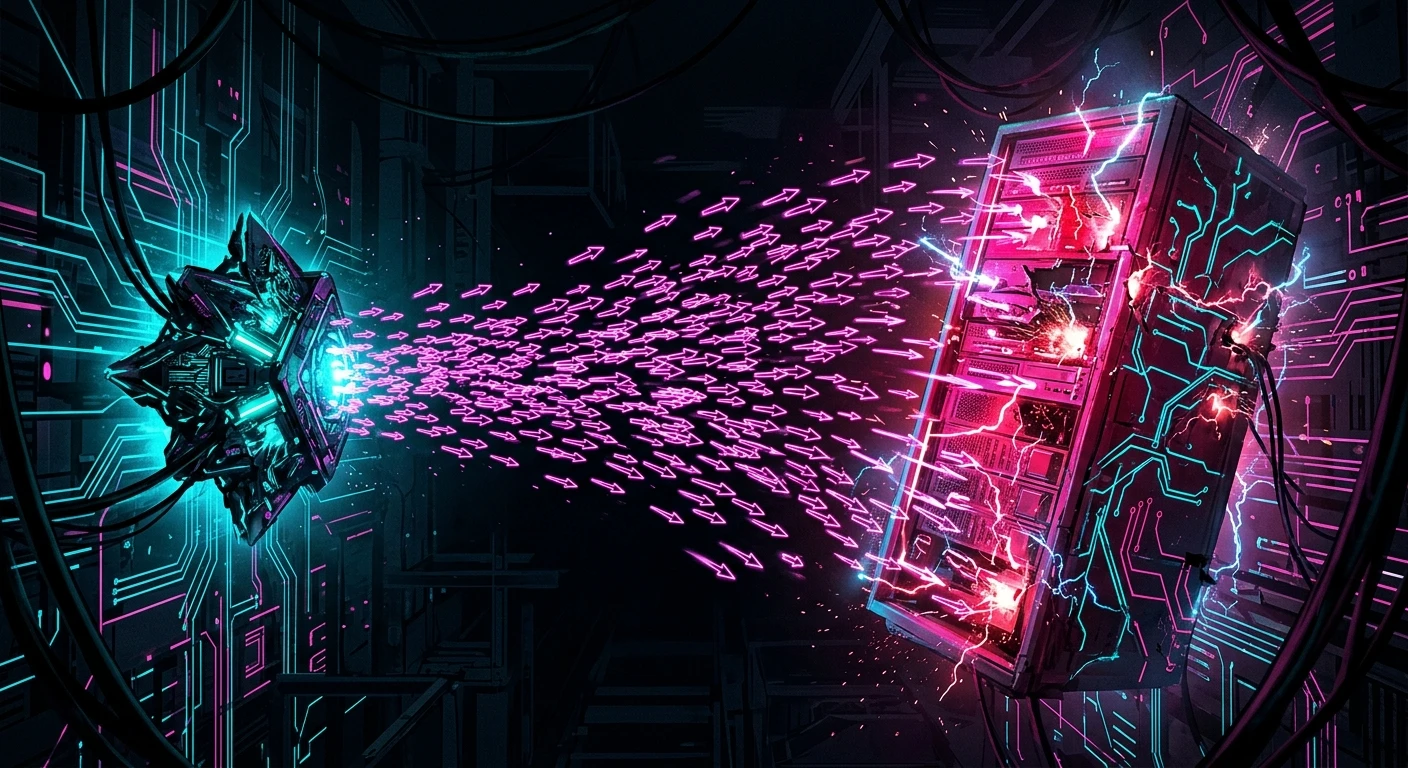
The Resilience Pattern That Becomes the Outage
Every production AI team eventually adds retries. A tool call fails or hangs, so you wrap it in a retry with a timeout, maybe a hedged backup request to a second endpoint, and you sleep better knowing a single transient blip will not take down a user interaction. It is the most basic resilience pattern there is, and in isolation it works exactly as designed. The problem is that your agent does not run in isolation. It runs as hundreds or thousands of concurrent instances, all pointed at the same backends, all carrying the same retry logic, all reacting to the same slowdown at the same instant.
That is when the pattern inverts. A backend gets slow -- not down, just slow. Every agent instance hits its timeout at roughly the same moment. Every one of them retries. Some of them fire hedged backup requests on top of the retries. In the space of a few seconds, the load on an already-struggling backend does not just stay constant, it multiplies. The slowdown that a healthy system would have shrugged off becomes a full outage, and the amplifier is the resilience logic you deployed to prevent exactly this. Retry storm amplification is the failure mode where recovery attempts become the primary source of load.
Why Agents Make This Dramatically Worse
Retry storms are an old distributed-systems problem, but agentic systems supply rocket fuel that traditional services never had.
Retries stack across layers. A traditional client retries once. An agent retries at the tool-call layer, the orchestration layer often retries the whole step, and the model itself may decide to try again because the first result looked incomplete. Three independent retry mechanisms, unaware of each other, multiply into far more than three attempts. This is why retry safety has to live in a coordinated place, the same argument for deterministic control planes in agentic AI rather than retry logic scattered across every layer.
Latency reshapes agent behavior, then agents reshape latency. When a tool gets slow, agents do not wait patiently -- they time out and retry, and that retry pressure makes the tool slower still, which triggers more timeouts. It is a positive feedback loop, and it rides directly on top of the tool latency tax, where slow tools quietly reshape what your agent decides to do.
Synchronization makes it worse than random. If every agent used a fixed timeout, they all give up at the same millisecond and retry in a synchronized wave -- the thundering herd. Fixed timeouts are the enemy here, which is why adaptive timeout strategies for agent tool calls matter as much as the retry policy itself.
Hedging doubles the floor. Hedged requests -- firing a backup call if the first is slow -- are wonderful for tail latency when the system is healthy. Under load they are catastrophic, because they guarantee a second request precisely when the backend can least afford it. Hedging without a load-aware kill switch is an amplifier disguised as a safeguard.
The Anatomy of a Storm
Picture a fleet of agents that each call a document-enrichment service. Baseline latency is 200ms; the service handles the load comfortably. A dependency of that service degrades and latency creeps to 3 seconds. Every agent has a 2-second timeout. Now every in-flight request times out, and every agent retries -- instantly doubling request volume against a backend that was already at its limit. The retries push latency to 6 seconds. The orchestration layer, seeing the step fail, retries the whole step, doubling volume again. Hedged backups fire. Within fifteen seconds the backend is receiving five to ten times its normal request rate, all of it doomed to time out, none of it doing useful work. The service falls over completely. A degradation that better-behaved clients would have ridden out has become a hard outage, and the logs will show it as a backend failure rather than what it was: a client-induced stampede.
And because nothing crashed on the agent side -- every instance is dutifully retrying -- the amplification is nearly invisible without request-level tracing. This is a textbook silent failure in agentic AI success metrics: the system reports that it is trying hard, while the trying is the disease.
How to Stop the Amplification
Retry storms are not solved by a single knob. They are solved by making the whole fleet behave like it knows other instances exist.
Put a circuit breaker in front of the retry. The moment a backend shows sustained failure, stop sending it traffic entirely and fail fast, giving it room to recover. A breaker converts a stampede into a controlled pause -- the core of circuit breakers in AI agent pipelines. Without one, every retry is kicking a system that is already down.
Make timeouts and backoff adaptive and jittered. Never use a fixed timeout across the fleet. Add exponential backoff with randomized jitter so retries spread out instead of arriving as a synchronized wave, and let timeouts track observed latency rather than a hardcoded constant, per adaptive timeout strategies.
Coalesce duplicate work. When many agents ask the same backend for the same thing during a slowdown, collapse those into a single in-flight request and fan the result back out, so a spike of demand does not become a spike of load. This is request coalescing in AI agent systems, and it directly defuses the herd.
Apply backpressure instead of retrying blindly. A healthy system sheds or queues load when saturated rather than accepting everything and failing everything. Explicit backpressure patterns for AI agent systems let the fleet slow itself down before it self-amplifies.
Bound the concurrency you point at any one backend. Connection and concurrency limits cap the maximum stampede size regardless of how many agents want in, which is one of the quieter benefits of disciplined connection pooling in AI agent tool integrations.
Make the storm observable before it is an outage. You cannot tune what you cannot see. Track retry rate as a first-class metric alongside success rate, and alert on retry amplification -- the ratio of attempts to distinct logical operations -- as described in observability for AI systems. When that ratio spikes, you are watching a storm form in real time.
The Takeaway
Retries, hedges, and failovers are not free resilience -- they are borrowed load that comes due at the worst possible moment. In a single client they are a safeguard; across a fleet of agents they are an amplifier, and the difference between the two is whether your system behaves like it knows it is not alone. Treat retry logic as a fleet-wide load-generation policy, not a per-call convenience, and put circuit breakers, adaptive backoff, coalescing, and backpressure between your agents and every backend they touch. The goal is not to retry harder. It is to make sure that when something gets slow, your own recovery logic is not the thing that finishes it off.
At Bigyan Analytics, we architect agentic systems that degrade gracefully instead of amplifying their own failures. If your resilience patterns might be your biggest outage risk, book a working session.
Founder & Principal Architect
Ready to explore AI for your organization?
Schedule a free consultation to discuss your AI goals and challenges.
Book Free Consultation