Schema Evolution Strategies for AI Agent Memory: Why Your Agent Knowledge Graph Breaks When Requirements Change
Agent memory systems work perfectly until your domain model changes. Then every stored embedding, every graph relationship, and every cached reasoning chain becomes a liability. Schema evolution for AI memory is the hardest infrastructure problem nobody is solving.
The Schema Problem Nobody Talks About
Every production AI agent team eventually hits the same wall. Your agent has been running for months. It has accumulated memory -- vector embeddings, graph relationships, conversation histories, learned preferences. The memory makes it smart. The memory makes it useful. The memory is also a ticking time bomb.
Because requirements change. Your domain model evolves. The entity that was "customer" now needs to distinguish between "prospect" and "active_customer" and "churned_customer." The relationship "owns" between users and resources now needs temporal boundaries. The embedding schema that captured product features at launch cannot represent the features you shipped since then.
In traditional software, schema migrations are solved problems. You write a migration script, run it against your database, and move on. In AI agent memory systems, schema evolution is an unsolved nightmare -- because you cannot simply ALTER TABLE on a vector embedding. You cannot run UPDATE queries on learned associations that exist as weight distributions across a neural architecture. You cannot migrate a knowledge graph that was built through inference rather than explicit insertion.
This is the infrastructure problem that separates teams running toy demos from teams operating production agents at enterprise scale. And almost nobody is addressing it systematically.
Why Agent Memory Is Not a Database
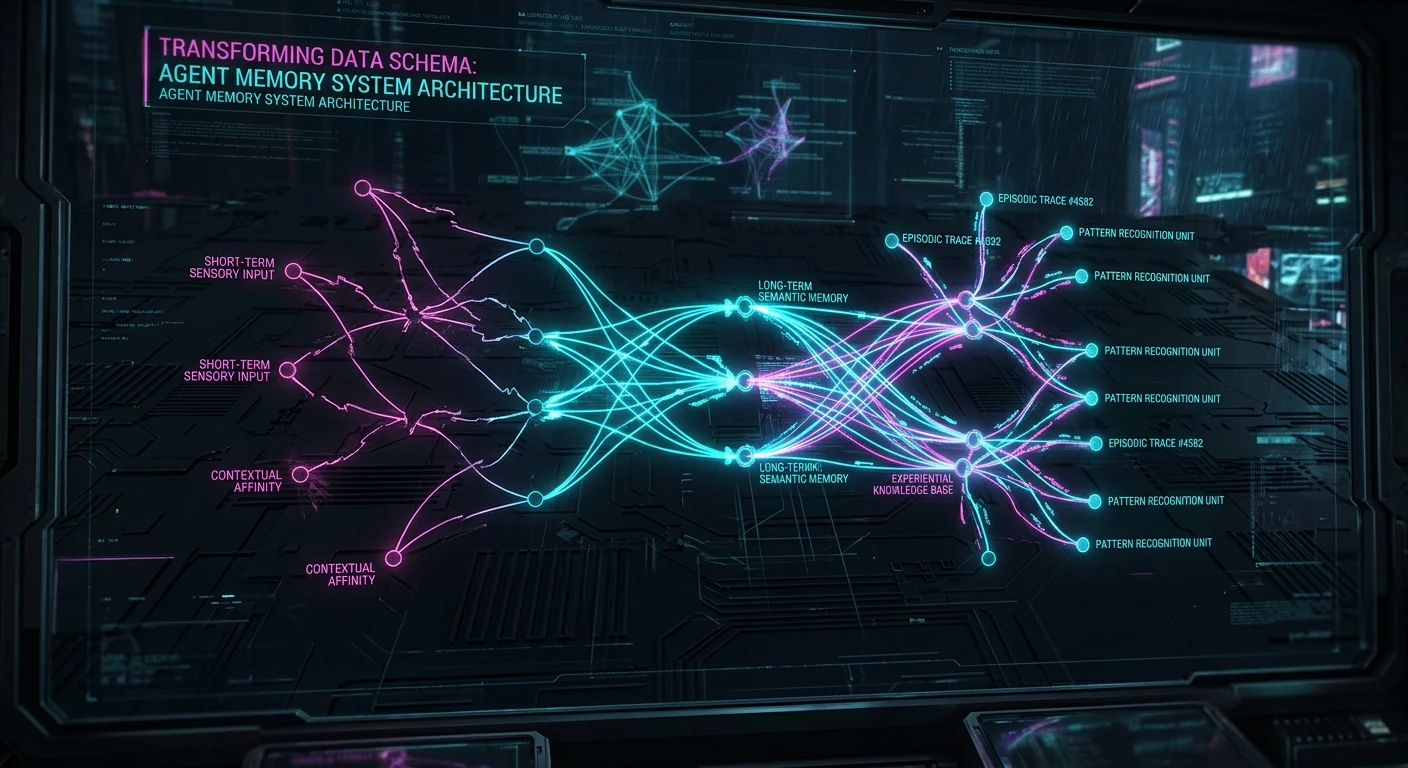
The fundamental confusion: teams treat agent memory as if it were a database with a different query interface. It is not. Agent memory systems combine multiple representational formats, each with different schema evolution characteristics:
Vector stores encode semantic meaning as high-dimensional numerical arrays. When your schema changes -- when "customer satisfaction" gains new dimensions or when product categories get restructured -- existing embeddings become semantically misaligned with new ones. An embedding generated under the old schema and an embedding generated under the new schema exist in different semantic spaces even though they occupy the same vector database. This connects to why vector search alone cannot power enterprise AI workflows -- the brittleness compounds as the system scales.
Knowledge graphs encode explicit relationships between entities. Schema evolution means adding node types, changing edge semantics, or restructuring hierarchies. Unlike relational databases, graph schemas are often implicit -- derived from usage patterns rather than declared upfront. You cannot migrate what you never defined.
Conversation histories encode interaction patterns, user preferences, and contextual decisions. When your agent's capabilities change, historical conversations reference tools that no longer exist, workflows that have been restructured, or entities that have been reconceptualized. The history becomes misleading rather than informative.
Learned behaviors encode patterns the agent extracted from experience -- which questions to ask, which tools to prefer, which response patterns work. Schema changes invalidate the conditions under which these behaviors were learned. The agent's intuitions become wrong.
Each of these memory types requires different evolution strategies. Treating them uniformly guarantees failure.
The Four Schema Evolution Patterns
Pattern 1: Versioned Embedding Spaces
The problem: embeddings generated with model version A are not directly comparable to embeddings generated with model version B, even for identical content. Switching embedding models (or even updating them) creates a semantic discontinuity in your vector store.
The solution: maintain embedding version metadata alongside every vector. When querying, either restrict queries to same-version embeddings or apply a learned transformation matrix that maps between embedding spaces.
Implementation approach:
- Tag every embedding with its schema version and model version at insertion time
- When schema changes require new embeddings, do NOT delete old ones immediately
- Run a background re-embedding process that generates new vectors for historical content
- During the transition period, query both spaces and merge results with version-aware ranking
- Once re-embedding is complete, archive (do not delete) the old space
This is expensive. Re-embedding a million documents is not free. But the alternative -- corrupted retrieval that silently returns semantically mismatched results -- costs more in incorrect agent behavior that nobody can diagnose. The same principle applies to configuration drift in AI systems -- silent misalignment causes failures that are invisible until catastrophic.
Pattern 2: Graph Schema Migration With Inference Preservation
Knowledge graphs in agent memory are not just storage -- they encode inferred relationships that the agent derived through reasoning. A naive schema migration that restructures the graph destroys these inferences, forcing the agent to re-derive knowledge it already possessed.
The approach:
- Maintain a schema registry that tracks graph ontology versions (connecting to the principles of versioned prompt registries)
- When adding new entity types or relationships, use additive-only migrations where possible
- For breaking changes, create a translation layer that maps old schema concepts to new ones
- Preserve inference provenance -- record not just WHAT the agent knows but HOW it derived that knowledge
- When schema changes invalidate an inference chain, flag it for re-derivation rather than silently serving stale knowledge
The key insight: in agent memory, the reasoning path matters as much as the conclusion. Migrating conclusions without migrating reasoning creates agents that "know" things they can no longer justify -- which breaks when they need to update those beliefs.
Pattern 3: Temporal Memory Boundaries
Sometimes the right evolution strategy is not migration but partitioning. Declare a temporal boundary: memory before this date was generated under schema V1. Memory after this date follows schema V2. The agent maintains awareness of both schemas and knows which context applies to which memories.
This pattern works when:
- The schema change reflects a genuine domain change (not just a modeling improvement)
- Historical memories remain valid within their original context
- The agent can reason about temporal context when accessing memories
- Cross-boundary queries are rare or can be handled with explicit translation
Implementation:
- Store a schema_version and effective_date with every memory entry
- Build schema-aware retrieval that applies appropriate interpretation based on memory vintage
- Give the agent explicit awareness that its memory spans multiple schema eras
- Build reconciliation logic for when the agent needs to synthesize across boundaries
This mirrors how organizations handle data warehouse migrations -- maintain the old warehouse frozen while building forward in the new one. The difference is that agents need to query across both simultaneously.
Pattern 4: Graceful Amnesia
The most counterintuitive pattern: sometimes the correct schema evolution strategy is deliberate forgetting.
When a schema change is fundamental enough that historical memory would actively mislead the agent, controlled amnesia is preferable to corrupted memory. An agent that knows nothing is better than an agent that "knows" wrong things with high confidence.
When to apply graceful amnesia:
- The domain model changed so fundamentally that old relationships are not just outdated but actively wrong
- The cost of re-deriving knowledge from scratch is lower than the cost of migrating corrupted state
- The agent can rebuild its memory from available source data (conversations, documents, interactions)
- Stakeholders accept a temporary capability degradation during the rebuild period
Implementation:
- Archive (never delete) the old memory state
- Reset the agent's active memory to empty
- Provide the agent with source materials to rebuild from
- Monitor memory reconstruction for quality
- Compare rebuilt memories against archived ones to validate the new schema captures equivalent knowledge
This feels drastic. It is. But it is dramatically better than the alternative most teams choose: doing nothing and hoping the agent's degrading memory does not cause visible problems until someone else's problem.
The Testing Problem
How do you test schema migrations for AI agent memory? Traditional database migration testing verifies row counts, constraint satisfaction, and query correctness. Agent memory migration testing must verify something far harder: that the agent's behavior remains correct after migration.
This requires eval-driven development applied to memory systems:
Behavioral regression tests. Define a set of queries/tasks that the agent should handle correctly. Run them before migration with the old schema. Run them after migration with the new schema. Compare behavioral outputs -- not memory contents, but actual agent decisions and responses.
Semantic equivalence checks. For migrated embeddings, verify that similarity relationships are preserved. If documents A and B were semantically close before migration, they should remain close after. If entity X was reachable from entity Y in the old graph, the equivalent traversal should work in the new graph.
Consistency audits. After migration, run the agent through scenarios that exercise migrated memories. Look for hallucinations (confident claims based on corrupted memory), contradictions (new and old memories conflicting), and gaps (memories that were lost in translation).
Canary deployments. Migrate memory for a subset of users/tenants first. Monitor agent quality metrics for that cohort versus the un-migrated baseline. This borrows from feature flag patterns for AI rollouts -- validate in production before full deployment.
The Multi-Tenant Dimension
Schema evolution is exponentially harder in multi-tenant agent platforms. Different tenants may be on different schema versions. One tenant's domain model might evolve on a different timeline than another's. Universal schema changes need to be rolled out gradually while maintaining backward compatibility.
The architecture that survives this:
- Per-tenant schema version tracking
- Schema-version-aware memory access layers
- Tenant-scoped migration queues that process asynchronously
- Fallback logic that degrades gracefully when a tenant's memory is mid-migration
As discussed in tenant isolation for multi-tenant AI platforms, shared infrastructure creates shared failures. A botched schema migration for one tenant should never corrupt another tenant's memory.
The Governance Overlay
Schema evolution in agent memory is not purely an engineering problem. It has governance implications that most teams ignore until an audit:
Data lineage. After a schema migration, can you trace which original data contributed to which current memory state? Audit trail requirements do not disappear because your data changed shape.
Consent alignment. If user data was collected under one schema (with one purpose and structure), does migrating it to a new schema remain within the bounds of original consent? This is not theoretical -- GDPR's purpose limitation principle applies to transformed data.
Rollback capability. If a schema migration introduces errors, can you restore the previous memory state? Governance frameworks typically require rollback capability for any production change. Agent memory migrations need the same discipline.
Building Schema-Evolution-Ready Agent Memory From Day One
The teams that handle schema evolution well are the ones that designed for it before their first schema change:
Immutable memory layers. Store raw inputs (conversations, documents, events) separately from derived memory (embeddings, graph relationships, learned patterns). Raw inputs survive any schema change. Derived memory can be regenerated.
Schema metadata everywhere. Every memory entry carries its schema version, creation date, derivation method, and source references. This metadata is not optional overhead -- it is the foundation of future migrations.
Abstraction between agent and memory. The agent should not query memory stores directly. A memory access layer should translate between the agent's conceptual needs and the underlying storage schema. When the schema evolves, only the access layer changes -- the agent's reasoning remains stable.
Automated memory health monitoring. Track retrieval quality metrics, consistency scores, and behavioral accuracy continuously. When schema drift begins degrading memory quality, you want to know before users notice.
This is not premature optimization. It is engineering for the inevitable. Every production agent system that survives more than six months will face schema evolution. The question is whether you designed for it or whether you are now scrambling to migrate a system that was never built to change.
Wrestling with agent memory that has outgrown its original design? Book a strategy session to discuss production-grade memory architecture that evolves with your requirements.
Founder & Principal Architect
Ready to explore AI for your organization?
Schedule a free consultation to discuss your AI goals and challenges.
Book Free Consultation