Semantic Routing Architectures for Multi-Agent Systems: Why Rule-Based Dispatchers Create Bottlenecks That Destroy Agent Autonomy
Your multi-agent system routes tasks through a central dispatcher with hand-coded rules. It worked at three agents. At fifteen agents handling novel request patterns, the dispatcher becomes the single point of failure that turns autonomous agents into queued workers waiting for permission from logic that cannot understand what they do.
The Dispatcher Bottleneck Nobody Planned For
Every multi-agent system starts with a dispatcher. A routing layer that receives incoming requests, classifies them, and sends them to the appropriate agent. In the early days -- three agents, well-defined task boundaries, predictable request patterns -- the dispatcher works beautifully. Clean separation of concerns. Deterministic routing. Easy debugging.
Then the system grows. You add agents for new capabilities. Request patterns diversify. Edge cases multiply. The dispatcher's rule set expands from 12 rules to 147 rules. Each new agent requires updating the routing logic. Each novel request pattern requires a new classification branch. The dispatcher that once enabled autonomy now constrains it.
This is the fundamental architectural flaw in rule-based multi-agent routing: the dispatcher must understand every agent's capabilities well enough to route correctly, but it cannot understand them because that understanding is precisely what each agent encapsulates. You have recreated the monolith inside your routing layer.
Why Rule-Based Routing Fails at Scale
Rule-based dispatchers operate on surface-level request classification. They pattern-match against keywords, intent categories, or structural features of incoming requests. This works when the mapping between request characteristics and agent capabilities is one-to-one and stable.
Real multi-agent systems violate both conditions:
Many-to-many capability mapping. Multiple agents can handle overlapping request types. A data analysis request might route to a SQL agent, a Python agent, or a visualization agent depending on context that rule-based routing cannot capture. The dispatcher either makes arbitrary choices or requires increasingly complex disambiguation logic.
Dynamic capability evolution. Agents improve, gain new capabilities, and develop specializations through deployment experience. A rule-based dispatcher cannot know that your document processing agent has become excellent at tabular data extraction unless someone manually updates the routing rules. The system's actual capabilities diverge from its routing model.
Compositional requests. Users do not submit requests that map cleanly to single agents. They submit requests that require coordination across multiple agents in patterns the dispatcher never anticipated. "Analyze last quarter's support tickets and generate a presentation" touches data retrieval, NLP analysis, and content generation -- routing it to any single agent is wrong, but the dispatcher has no concept of multi-agent orchestration.
The result is a system where the dispatcher becomes the primary source of errors and the primary constraint on capability expansion. Every new agent makes the routing problem harder. Every novel request pattern exposes gaps in the rule set. The translation layer problem in research tools describes an analogous issue: the intermediary layer's assumptions about what is possible constrain what can actually happen.
Semantic Routing as an Alternative Architecture
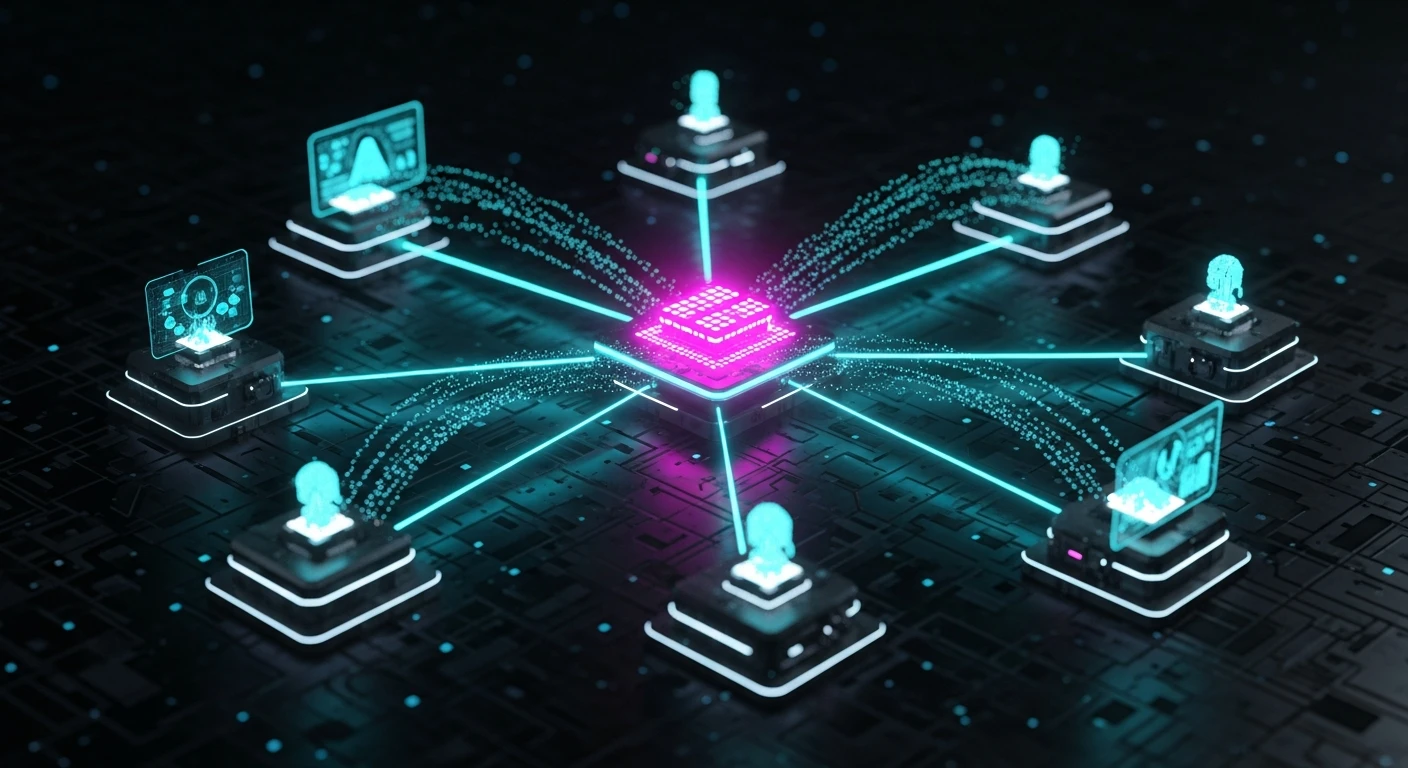
Semantic routing replaces rule-based classification with embedding-based similarity matching. Instead of asking "which rule matches this request?" it asks "which agent's capability description is most semantically similar to this request?"
The architecture works as follows:
Agent capability vectors. Each agent publishes a semantic description of its capabilities -- not rigid keywords, but natural language descriptions of what it does, what it does well, what it cannot do, and what input formats it prefers. These descriptions are embedded into vector representations.
Request embedding. Incoming requests are embedded using the same model. The request vector captures the semantic intent, not just surface-level keywords.
Similarity routing. The router computes similarity between the request vector and all agent capability vectors. The highest-similarity agent (or agents, for compositional requests) receives the task.
Confidence thresholds. When no agent's capability vector exceeds the similarity threshold, the system knows it has encountered a genuinely novel request rather than silently misrouting it.
This architecture eliminates the rule maintenance burden entirely. Adding a new agent requires publishing a capability description, not updating routing logic. Agent capability evolution is captured by updating the capability description, not refactoring a rule engine.
The Autonomy Preservation Principle
Semantic routing preserves agent autonomy in a way that rule-based routing cannot. When rules determine which tasks an agent receives, the agent's effective capability is constrained by the dispatcher's model of that capability. When semantic similarity determines routing, the agent's actual published capabilities determine what it receives.
This distinction matters for agentic systems that learn and adapt. An agent that discovers it can handle a new task type can update its capability description and immediately begin receiving relevant requests. In a rule-based system, that same discovery requires a human to update routing logic -- creating a permanent lag between actual capability and routed workload.
The principle extends to failure handling. When a semantically-routed agent receives a task it cannot handle, it can reject it with a semantic explanation that updates the routing model. The system learns from failures. Rule-based dispatchers do not learn -- they repeat the same routing errors until someone manually fixes the rules.
Implementation Patterns
Production semantic routing requires several components beyond basic vector similarity:
Hierarchical routing. Large agent fleets benefit from two-stage routing: first to an agent category (semantic similarity against category descriptions), then to a specific agent within the category (finer-grained capability matching). This reduces the comparison space and improves routing latency.
Context-aware embedding. Request embeddings should incorporate conversation history, user context, and system state -- not just the raw request text. The same request from different contexts may require different agents. The challenge mirrors how context windows affect analysis quality -- losing context destroys meaning.
Feedback loops. Route-then-evaluate cycles where agent performance on routed tasks feeds back into capability vector refinement. Agents that consistently succeed with certain request types should attract more similar requests. Agents that fail should see their effective routing space contract.
Fallback orchestration. When semantic routing identifies multiple viable agents with similar confidence scores, the system needs orchestration logic to determine whether to fan-out (parallel execution), sequence (waterfall), or compete (race). This orchestration layer operates above routing and handles the compositional request problem.
The Tool Sprawl Parallel
Enterprise organizations building multi-agent systems face the same architectural challenge that research operations teams face with tool sprawl: as the number of components grows, the integration layer becomes the primary constraint on system capability.
Rule-based dispatchers are the multi-agent equivalent of manual workflow routing in research ops. They work at small scale because humans can maintain the mapping in their heads. They fail at enterprise scale because the combinatorial explosion of possible routes exceeds human management capacity.
Semantic routing is the multi-agent equivalent of AI-powered workflow automation: it scales with the system rather than constraining it, adapts to new components without manual reconfiguration, and degrades gracefully when encountering novel situations.
When Rule-Based Routing Still Wins
Semantic routing is not universally superior. Rule-based dispatchers remain appropriate when:
Compliance requires determinism. In regulated environments where you must prove exactly why a request was routed to a specific agent, deterministic rules provide auditability that probabilistic semantic matching cannot. Though audit trails can be constructed for semantic routing, they require additional infrastructure.
Agent count is stable and small. If your system has three agents with non-overlapping capabilities and you do not plan to add more, the engineering investment in semantic routing infrastructure is unjustified. Rules work fine when the routing problem is simple.
Latency is critical. Embedding computation and vector similarity search add latency compared to rule evaluation. For systems where routing latency must be sub-millisecond, rules are faster. Though caching and pre-computation can mitigate this, they add architectural complexity.
The architectural decision should be driven by growth trajectory. If you expect your agent fleet to grow, capabilities to evolve, and request patterns to diversify, invest in semantic routing early. The migration cost from rules to semantic routing increases exponentially with system size -- and so does the constraint that rules impose on system evolution.
As context engineering in AI-driven development demonstrates, the systems that win long-term are those designed for adaptation from the start, not those optimized for today's requirements at the cost of tomorrow's flexibility.
The Path Forward
Multi-agent systems are entering the phase where routing architecture determines system ceiling. Teams that invest in semantic routing now -- capability vector registries, embedding-based similarity matching, feedback-driven routing refinement -- will build systems that scale with agent count rather than against it.
The teams that stick with rule-based dispatchers will hit a wall. Not immediately. Not at five agents. But at twenty, thirty, fifty agents with evolving capabilities and diversifying request patterns, the dispatcher will become the bottleneck that prevents the system from realizing the autonomy its individual agents are capable of.
The choice is architectural. Make it early, or pay for it later.
Founder & Principal Architect
Ready to explore AI for your organization?
Schedule a free consultation to discuss your AI goals and challenges.
Book Free Consultation