Service Mesh Patterns for AI Agent Communication: Why Direct Agent-to-Agent Calls Create Unobservable Failure Cascades
Your multi-agent system works in development because agents call each other directly. In production, one slow agent creates a cascading timeout that brings down your entire pipeline -- and you cannot even see where it started because there is no communication layer to observe.
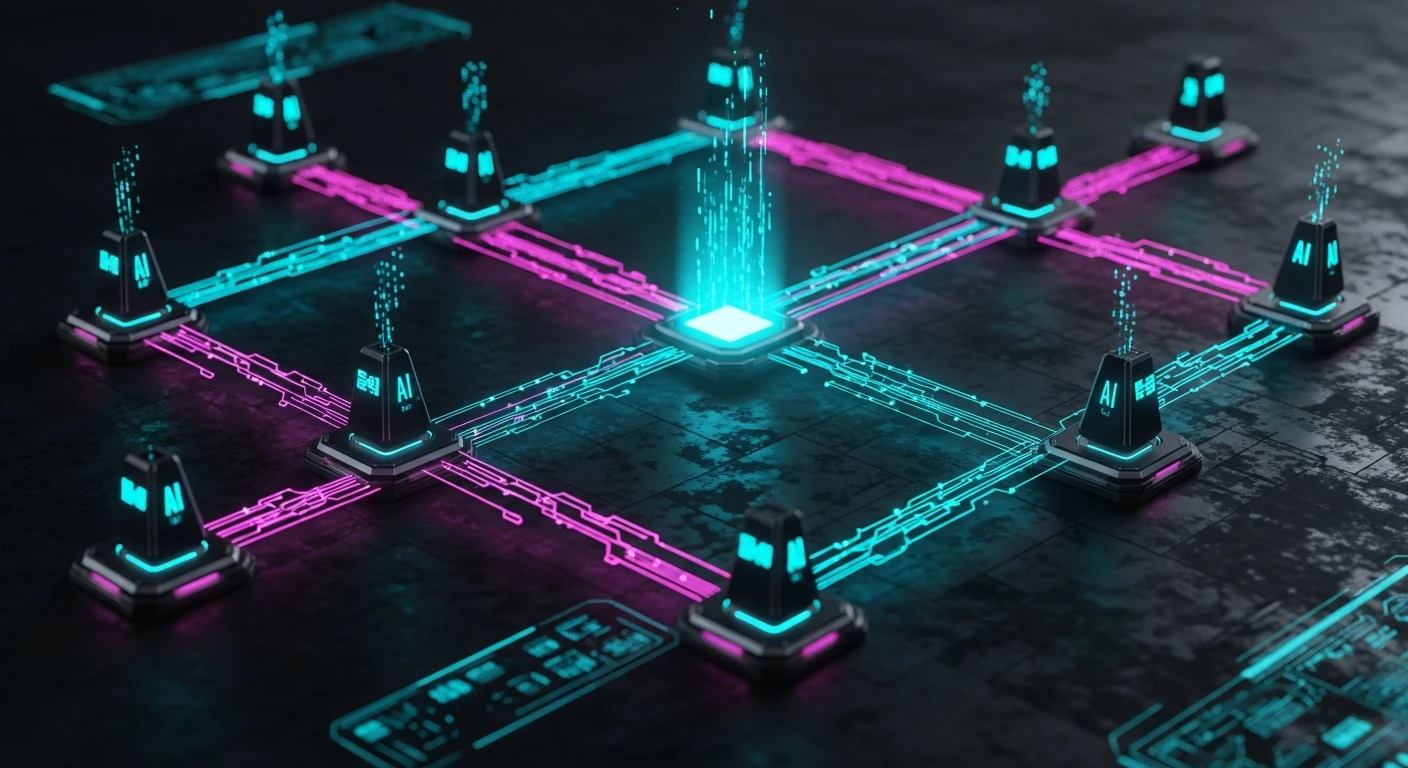
The Direct Call Antipattern
Multi-agent systems start simple. Agent A needs information from Agent B, so it calls Agent B directly. Agent B needs a decision from Agent C, so it calls Agent C. The system works. Demos impress. Leadership approves production deployment.
Then production traffic arrives. Agent B takes 30 seconds instead of 3. Agent A's timeout fires. The orchestrator retries. Now there are two pending requests to Agent B. Agent C, waiting on Agent B's output, starts accumulating its own timeout queue. Within minutes, your entire agent fleet is locked in a cascade of waiting, retrying, and timing out -- and your observability dashboard shows nothing because there is no instrumentation layer between agents.
This is not a scaling problem. It is an architecture problem. You built a distributed system without the distributed systems primitives that make production viable.
Why Agent Systems Need a Communication Layer
Traditional microservices solved this problem years ago with service meshes -- infrastructure layers that sit between services to provide observability, traffic management, security, and resilience. AI agent systems face the same fundamental challenges but have largely ignored these solutions, treating each agent as an independent function call rather than a participant in a distributed system.
The difference is that agent communication is worse than microservice communication in every dimension that matters for production reliability:
Non-deterministic latency. A database query takes roughly the same time every execution. An LLM inference call can take 2 seconds or 45 seconds depending on output length, provider load, and the specific reasoning path the model takes. Traditional timeout strategies built for predictable latency distributions fail catastrophically with AI workloads.
Semantic failures invisible to infrastructure. An agent can return a valid HTTP 200 response with structurally correct JSON that is completely wrong semantically. The communication layer must understand enough about agent contracts to detect these failures -- something traditional service meshes never needed to handle.
Stateful conversation context. Agents maintain conversational state that cannot simply be replayed. If Agent A's request to Agent B fails mid-conversation, you cannot just retry the last message -- you may need to replay the entire interaction sequence or accept partial results. This is fundamentally different from stateless request-response patterns.
The Service Mesh Architecture for Agents
The Sidecar Pattern Adapted
In traditional service mesh architecture, each service gets a sidecar proxy that handles all network communication. For agent systems, the sidecar equivalent handles:
Request interception and enrichment. Before Agent A's message reaches Agent B, the sidecar captures the full request context: originating trace ID, token budget remaining, deadline propagation, and semantic contract expectations. This metadata is invisible to the agents themselves but critical for operational observability.
Response validation. The sidecar validates Agent B's response against the expected schema and semantic contract before forwarding it to Agent A. A structurally valid but semantically empty response gets flagged before it propagates downstream -- a pattern that connects to how circuit breakers must operate differently for AI systems where failure modes are semantic rather than infrastructural.
Retry and fallback logic. Instead of each agent implementing its own retry logic (which leads to retry storms), the mesh handles retries with global coordination: exponential backoff, circuit breaking, and budget-aware retry policies that prevent cascading load.
Traffic Management for Non-Deterministic Workloads
Traditional load balancing distributes requests evenly across service instances. For agent fleets, even distribution is wrong. An agent instance processing a complex reasoning chain should receive fewer new requests than one handling simple lookups.
The mesh implements cognitive-load-aware routing:
- Track each agent instance's current context window utilization
- Monitor inference latency trends per instance (increasing latency signals increasing cognitive load)
- Route new requests to instances with headroom rather than distributing uniformly
- Shed load proactively when aggregate fleet capacity approaches saturation
This approach acknowledges what most teams learn the hard way: agent capacity is not about CPU or memory -- it is about cognitive bandwidth, and that bandwidth varies per-request in ways traditional autoscaling cannot predict.
Observability Without Agent Modification
The most valuable property of a service mesh is that it provides observability without modifying the services themselves. For agent systems, this means:
Communication topology mapping. Which agents talk to which? How frequently? What is the fan-out pattern? You discover your actual production topology rather than assuming it matches your architecture diagram.
Latency distribution per edge. Not just average latency between agents, but the full distribution -- because in AI systems, P99 latency can be 20x P50, and that tail creates your cascading failures. This level of observability for AI systems requires instrumentation at the communication layer, not just within individual agents.
Semantic contract violation rates. How often does Agent B return responses that do not meet Agent A's expectations? This metric -- impossible to capture without a communication layer -- reveals integration degradation long before it causes user-visible failures.
Token flow accounting. The mesh tracks total tokens consumed across the entire request path, enabling cost attribution per user request rather than per agent instance. Finance teams can finally understand why specific customer workflows cost 10x more than others.
Implementation Patterns
The Lightweight Agent Proxy
For teams not ready to adopt a full mesh infrastructure, start with a lightweight proxy pattern. Deploy a single intermediary service that all agent-to-agent communication routes through:
- Agent A sends request to Proxy with destination Agent B
- Proxy logs request, starts trace span, checks circuit breaker state
- Proxy forwards to Agent B with deadline header
- Proxy validates response schema, logs response, closes trace span
- Proxy returns response to Agent A (or fallback if validation fails)
This single-proxy pattern captures 80% of the observability value with minimal architectural change. The tradeoff is that the proxy becomes a single point of failure -- acceptable for most teams starting their production AI journey but insufficient at scale.
Deadline Propagation
The most impactful single pattern from service mesh architecture: deadline propagation. When a user request enters your system with a 10-second SLA, that deadline must propagate to every agent in the call chain.
Agent A has 10 seconds. It spends 2 seconds on its own processing, then calls Agent B with an 8-second deadline. Agent B spends 3 seconds, then calls Agent C with a 5-second deadline. Agent C knows it has exactly 5 seconds to respond -- and can make intelligent decisions about depth-versus-speed tradeoffs.
Without deadline propagation, Agent C has no idea that the overall request is about to timeout. It happily spends 30 seconds on deep reasoning while Agent A has already returned an error to the user. The compute is wasted. Worse -- Agent C's eventual response may trigger downstream side effects that now conflict with the error-recovery path.
Semantic Circuit Breaking
Traditional circuit breakers trip on error rates or latency thresholds. Agent systems need semantic circuit breakers that trip on quality degradation:
- Track a rolling window of Agent B's response quality scores (from validation or downstream feedback)
- When quality drops below threshold, the circuit breaker opens
- Requests route to a fallback agent or cached response rather than getting a low-quality answer
- The circuit breaker half-opens periodically to test if Agent B's quality has recovered
This pattern prevents the insidious failure mode where an agent continues operating but its output quality has degraded -- what happens when research tool sprawl creates similar invisible degradation in human workflows.
The Organizational Barrier
The technical patterns are straightforward. The organizational barrier is not.
Most teams building multi-agent systems are ML/AI teams, not distributed systems teams. They think in terms of prompts, models, and evaluations -- not in terms of service-level objectives, traffic management, and failure domains.
The shift required is architectural maturity: treating your agent fleet as a distributed system first and an AI system second. The AI part -- the reasoning, the generation, the tool use -- runs inside each agent. But everything between agents is a distributed systems problem, and distributed systems have fifty years of battle-tested solutions that the AI community is currently reinventing poorly.
As AI engineering matures beyond the model myth, the teams that win in production will be those that recognize their agent fleet is not a collection of smart functions -- it is a distributed system that happens to use LLMs as its compute primitive. And distributed systems need infrastructure. Ignoring that need does not make the problems disappear. It just makes them invisible until they cascade.
Getting Started
If your multi-agent system currently uses direct agent-to-agent calls:
-
Add a request ID to every agent call. Even without a mesh, correlating requests across agents is transformative for debugging.
-
Implement deadline propagation. Pass remaining time budget with every inter-agent call. Let agents make intelligent depth-vs-speed tradeoffs.
-
Log at the boundary. Capture every request and response between agents in a structured format. You cannot improve what you cannot observe.
-
Add schema validation on responses. Catch semantic failures at the communication boundary before they propagate downstream.
-
Implement a single circuit breaker per agent dependency. When Agent B starts failing, stop sending it traffic rather than letting it drag down the entire system.
These five steps -- none of which require a full mesh deployment -- will prevent most cascading failures and give you the observability to diagnose the rest. The full mesh comes later, when your agent topology is complex enough to justify the infrastructure investment.
But start now. Because in production, the failure you cannot see is the one that wakes you at 3 AM.
Founder & Principal Architect
Ready to explore AI for your organization?
Schedule a free consultation to discuss your AI goals and challenges.
Book Free Consultation