The Silent Failure Problem in Agentic AI: Why Your Success Metrics Are Hiding Broken Tool Calls
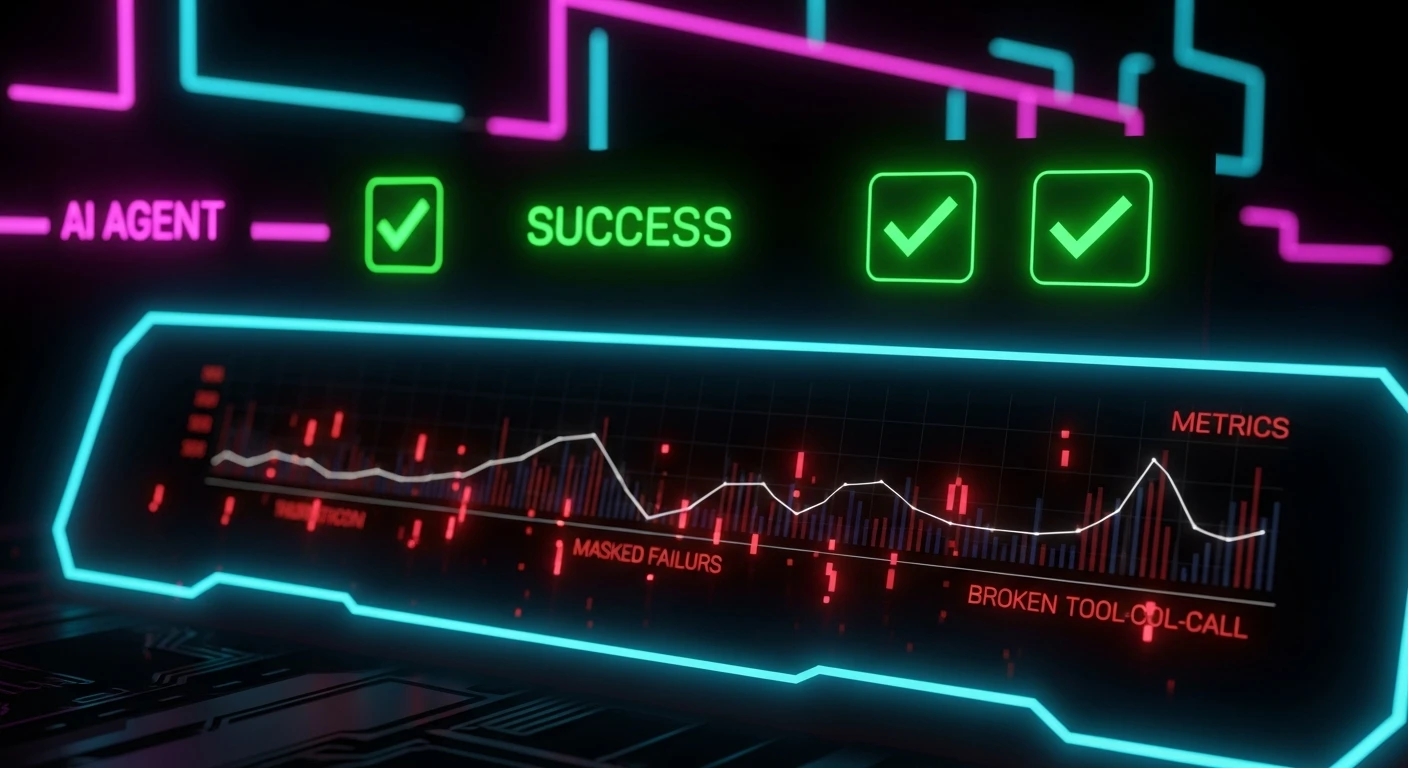
Your agent dashboard is green. Task completion is up, latency is fine, error rates are near zero. And yet the system is failing constantly -- because the agent is treating rejected tool calls, empty results, and half-finished work as success and narrating right past them. The most dangerous failures in agentic systems are the ones your metrics were designed to never see.
The Dashboard That Lies
There is a specific kind of green dashboard that should terrify you: the one over a production agentic system that reports 98% task completion, sub-second p95 latency, and an error rate rounding to zero -- while the system underneath it is quietly failing dozens of times an hour. Not crashing. Failing. The two are not the same, and conflating them is the defining observability mistake of the agentic era.
Traditional software fails loudly. An unhandled exception, a 500, a timeout -- something turns red, a counter increments, an alert fires. Agentic systems fail softly, because a language model sits in the middle of the control flow whose entire training objective is to produce a plausible continuation no matter what just happened. Hand it a rejected tool call, an empty search result, or a malformed API response, and it will not halt. It will improvise. It will apologize, retry with different arguments, choose a different tool, or -- most dangerously -- simply narrate a successful-sounding outcome and move on. The task completes. The metric ticks up. The failure is now invisible.
Why Success Metrics Are the Wrong Instrument
The problem is structural. Most agent metrics are defined at the boundaries -- did the request come in, did a response go out, how long did it take -- and treat everything in between as a black box. But in an agentic system, the interesting failures live entirely inside that box, in the multi-step trajectory of tool calls the agent makes to get from request to response. A run that made eight tool calls, had three of them rejected, hallucinated its way past two empty results, and still emitted a fluent final answer looks identical, at the boundary, to a run where all eight calls succeeded.
This is why aggregate success rate is close to useless as a health signal for agents. It measures whether the agent produced an answer, not whether the answer was earned. A model that is very good at generating confident prose -- which is to say, every modern model -- will keep your completion rate high precisely by papering over the failures you most need to see. The metric is not just insufficient; it is actively anticorrelated with the truth, rewarding the exact behavior that hides the problem. Real observability for these systems has to instrument the trajectory, not the endpoints, which is the whole premise behind treating observability for AI systems as a distinct discipline from traditional monitoring.
The Taxonomy of Silent Failure
Silent failures are not a single bug. They are a family, and naming them is the first step to catching them.
The swallowed rejection. A tool call returns an error -- bad arguments, a permission denial, a 4xx -- and the agent, rather than surfacing it, reasons around it. It tries again with guessed parameters, or abandons the tool and fabricates what the tool would have told it. The user gets an answer built on a call that never succeeded.
The empty-result hallucination. A retrieval or search tool returns nothing, correctly, because the data is not there. The agent, unwilling to admit it found nothing, fills the void with a confident synthesis of what it expected to find. This is the agentic cousin of every RAG failure mode, and it is why retrieval freshness and correctness in enterprise RAG has to be monitored at the result level, not assumed from a healthy query count.
The partial completion. A multi-step task requires five actions; the agent does three, hits friction on the fourth, and declares the whole thing done. Nothing errored -- the agent simply decided, mid-trajectory, that good enough was done. These half-finished trajectories are invisible to any metric that only checks whether a final response was produced.
The compensating retry storm. The agent hits a transient failure and retries, and retries, and retries -- eventually succeeding, or eventually giving up and confabulating. The run succeeds but consumed 40 tool calls to do a 4-call job, and in a fleet those hidden retries amplify into a retry storm across the whole system while your success dashboard stays serenely green.
Why Agents Are Uniquely Prone to This
Every other component in your stack fails closed. A database that cannot answer a query raises an error. A microservice that cannot reach a dependency returns a 503. An agent fails open: its default behavior in the face of failure is to keep going and produce something. This is not a bug you can patch out -- it is the direct consequence of putting a generative model in a decision-making loop, and it means the system's own competence is what hides its failures.
The more capable the model, the better it is at this camouflage. A weak model that cannot recover from a failed tool call will produce visibly broken output; a strong one will produce beautifully coherent output that happens to be built on a foundation of swallowed errors. As models improve, silent failure gets worse, not better, because the improvisation gets more convincing. This is precisely why eval-driven development for AI systems has to test trajectories and failure handling explicitly -- an eval that only grades final answers will happily bless a system that lies fluently.
Instrumenting for Failure, Not Success
The fix is a mindset inversion: stop measuring whether the agent succeeded and start measuring whether it failed silently. Concretely:
Instrument every tool call as a first-class event. Log the call, its arguments, its raw result, and whether that result was an error, an empty set, or a substantive payload. Aggregate rejection rates and empty-result rates per tool. A tool whose rejection rate is climbing is a silent failure in progress, regardless of what your completion metric says. This is the trajectory-level visibility that distributed tracing for multi-agent observability is built to provide.
Separate task completion from task success. Completion means the agent stopped and emitted a response. Success means the response was actually grounded in successful tool calls. Track them as two different numbers and watch the gap between them -- that gap is your silent-failure rate, and it is the single most important metric no default dashboard shows you.
Make the agent fail closed on the actions that matter. For any tool call with a real side effect, the system -- not the model -- must decide what happens on failure. Wrap consequential actions in idempotency and explicit failure semantics so that a rejected call cannot be smoothed over by improvisation, and route unrecoverable failures to deterministic control-plane logic that halts rather than hallucinates.
Audit the trajectory, not just the outcome. When you review agent runs, review the full sequence of calls and results, and record it durably. Being able to reconstruct exactly which tools failed, when, and how the agent responded is the same governance discipline behind audit trails and explainability for enterprise AI -- and it is what turns a silent failure from an invisible loss into a debuggable event.
Alert on shape, not just volume. A sudden shift in the distribution of tool-call outcomes -- more empties, more rejections, more retries per task, longer trajectories -- is a leading indicator of degradation that fires long before your completion rate ever moves. This is drift detection applied to behavior instead of data.
The Organizational Root Cause
Silent failure persists because the incentives around it are backwards. Success metrics are the ones that go in the board deck; they are the numbers a team is rewarded for making go up. Nobody gets promoted for surfacing that the agent has been quietly failing 15% of the time behind a green dashboard. So the instrumentation that would reveal it never gets built, and the system's true reliability stays unknown -- not because it is hard to measure, but because measuring it is uncomfortable.
Elite teams invert this deliberately. They treat the gap between completion and grounded success as their headline reliability number, they instrument tool calls as rigorously as they instrument requests, and they design their agents to fail closed on anything that touches the real world. The teams that do not will keep shipping systems that demo perfectly, report beautifully, and fail constantly -- right up until a silent failure becomes a very loud one in front of a customer.
If your agents are in production and you cannot answer what the gap is between your task completion rate and your actual success rate, you do not have an observability dashboard. You have a mirror telling you what you want to hear. Book a working session with Bigyan Analytics and we will help you instrument the failures your current metrics are built to hide.
Founder & Principal Architect
Ready to explore AI for your organization?
Schedule a free consultation to discuss your AI goals and challenges.
Book Free Consultation