Tenant Isolation for Multi-Tenant AI Agent Platforms: Why Shared Infrastructure Creates Shared Failures
Your AI agent platform serves fifty customers on shared infrastructure. One tenant's runaway prompt loop saturates your GPU pool, and forty-nine other customers experience degraded performance simultaneously. Multi-tenancy for AI agents requires isolation patterns that traditional SaaS never needed.
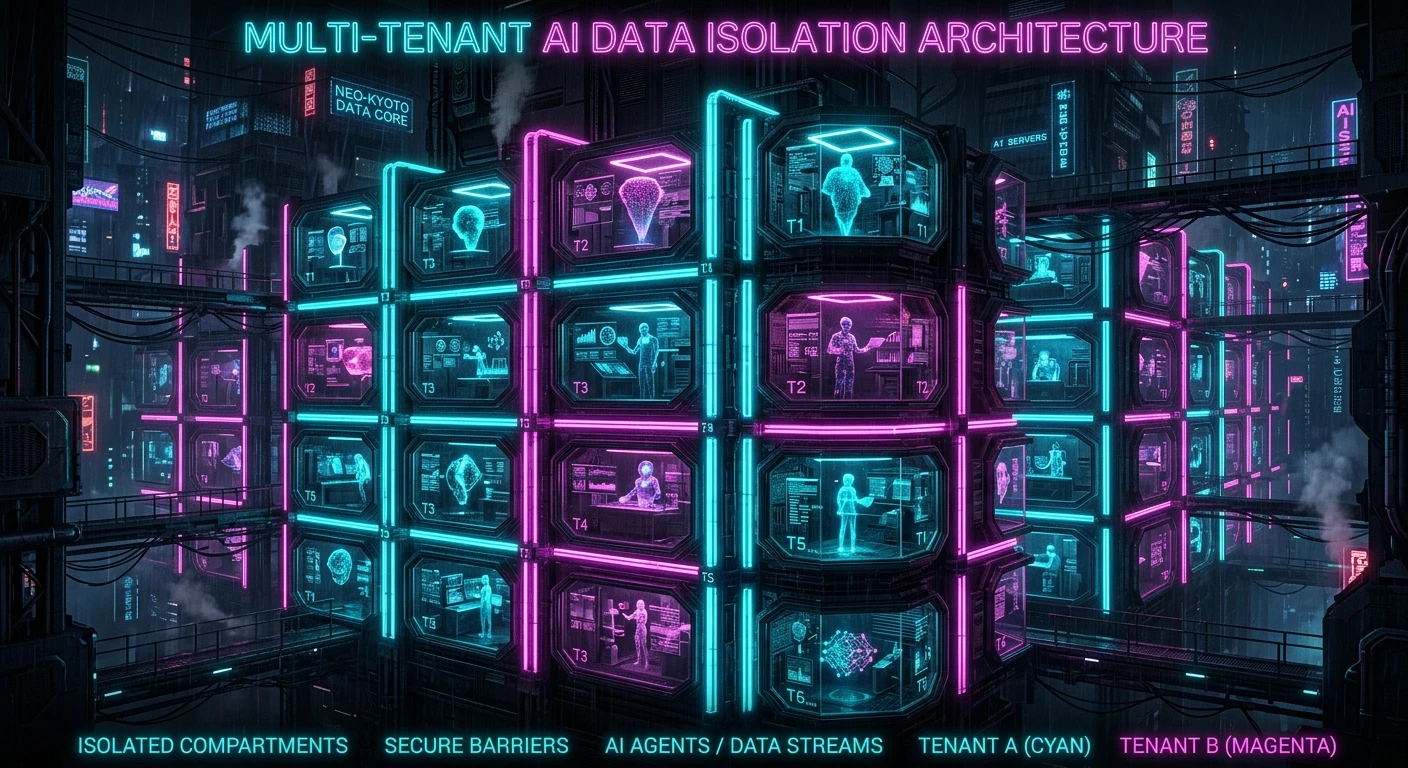
The Shared GPU Pool Problem
Traditional multi-tenant SaaS isolates compute at the request level. A web request takes 50ms of CPU, touches a partitioned database row, and returns. Resource contention between tenants is manageable because individual operations are small and fast. Rate limiting is straightforward: cap requests per second per tenant and the system stays stable.
AI agent platforms shatter these assumptions. A single agent invocation might consume a GPU for thirty seconds of inference, chain fifteen LLM calls sequentially, spawn sub-agents that multiply resource consumption unpredictably, and hold memory state that grows unbounded. One tenant running a poorly constrained research agent can consume more resources than the other forty-nine tenants combined — not through malice, but through the inherent unpredictability of autonomous agent behavior.
This is not hypothetical. Every production multi-tenant agent platform has experienced noisy-neighbor incidents where one tenant's agent loop destabilizes the entire system. The question is not whether it happens, but whether your architecture contains the blast radius.
Five Isolation Dimensions for Agent Platforms
Traditional SaaS thinks about isolation as a single spectrum from shared-everything to dedicated-everything. Agent platforms need isolation across five distinct dimensions, each with different cost-performance tradeoffs:
1. Compute isolation. GPU and CPU allocation per tenant. Options range from shared pools with quotas (cheapest, least isolated) to dedicated GPU instances per tenant (expensive, fully isolated). The middle ground is reserved capacity within shared clusters — guaranteed minimums with burst capability that cannot steal from other tenants' reservations.
2. Memory isolation. Agent state, conversation history, and working memory must be tenant-partitioned with no cross-contamination. This sounds obvious until you realize that shared embedding models accumulate key-value cache across requests, shared vector stores can leak semantic proximity between tenant documents, and shared context windows in pooled inference can retain cross-tenant information. The principles of AI memory architecture for enterprise agents become critical here — stateful agents in multi-tenant environments need memory boundaries that are architecturally enforced, not just logically separated.
3. Model isolation. Fine-tuned models, prompt templates, and system instructions are tenant-specific intellectual property. Model routing must guarantee that Tenant A's custom instructions never influence Tenant B's agent behavior. This extends to hot-swap model routing patterns where tenant-specific model configurations must survive failover without cross-contamination.
4. Tool isolation. Agents call external tools — APIs, databases, file systems. Each tenant's tool credentials, connection pools, and rate limits must be fully isolated. A compromised tool integration for one tenant cannot become a lateral movement vector to another tenant's systems. This connects to capability-based access control where each agent's tool permissions are scoped to exactly what that tenant authorized.
5. Observability isolation. Logs, traces, and metrics must be tenant-partitioned so that one tenant's debugging never exposes another tenant's data. This is more complex than it sounds because agent traces naturally contain the content they process — an observability leak is a data leak.
The Noisy Neighbor Taxonomy
Not all noisy-neighbor problems are equal. Agent platforms experience three distinct failure modes:
Resource exhaustion. One tenant's agent consumes all available compute, starving others. Classic resource contention but amplified because agent workloads are bursty and unpredictable. A research agent that decides to process 10,000 documents consumes resources differently than one processing 10.
Cascade failures. One tenant's agent triggers a bug in shared infrastructure (model server crash, queue overflow, cache corruption) that affects all tenants. This is worse than resource contention because isolation alone does not prevent it — you need circuit breakers at the tenant boundary that prevent one tenant's failure from propagating through shared components.
Poisoned shared state. Shared caches, shared embedding indices, or shared model state accumulate one tenant's data in ways that subtly influence other tenants. This is the hardest to detect because it manifests as quality degradation rather than availability failure. Semantic caching in multi-tenant environments is particularly vulnerable — a cache hit that returns Tenant A's cached response to a semantically similar query from Tenant B is both a performance optimization and a data breach.
Architecture Patterns That Work
Cell-based architecture. Partition tenants into cells (groups of 5-10) that share infrastructure within the cell but are fully isolated between cells. Blast radius is limited to cell size. New tenants get assigned to cells based on predicted resource consumption. High-consumption tenants get their own cell. This mirrors how the compound AI system architecture handles multi-model orchestration — bounded subsystems that fail independently.
Token budget enforcement. Every tenant gets a token budget per time window (minute, hour, day). Agent orchestrators check budgets before every LLM call and hard-stop agents that exceed limits. This prevents runaway loops from consuming unbounded resources. The budget is not just billing — it is an isolation mechanism that prevents one tenant from affecting platform stability.
Tenant-scoped queues. Agent task queues are partitioned per-tenant with independent processing capacity. A backed-up queue for one tenant cannot delay task processing for others. Backpressure patterns apply per-tenant rather than globally — one tenant hitting backpressure should only degrade that tenant's experience.
Execution sandboxing. Agent tool calls execute in tenant-scoped sandboxes with independent failure domains. A hung API call for one tenant does not consume a shared connection pool slot that another tenant needs. Each sandbox has its own timeout policies, retry budgets, and resource limits.
The Cost-Isolation Tradeoff
Full isolation is expensive. Dedicated GPU instances per tenant multiply infrastructure costs 10-50x compared to shared pools. The practical question is: what isolation level does each tenant need?
Tier 1: Shared pools with quotas. Suitable for low-volume tenants with predictable workloads. Cheapest but most vulnerable to noisy neighbors. Acceptable when tenants understand the tradeoff.
Tier 2: Reserved capacity in shared clusters. Guaranteed resource minimums with burst allowance. Good middle ground for most production tenants. Noisy neighbor impact limited to burst capacity.
Tier 3: Dedicated cells. Full infrastructure isolation for enterprise tenants who require it contractually (financial services, healthcare, government). Expensive but eliminates cross-tenant risk entirely.
The tiering maps directly to pricing — tenants who need more isolation pay for more isolation. This is not just infrastructure cost recovery; it is risk pricing. As organizations that understand AI governance frameworks recognize, isolation requirements often come from compliance rather than performance needs.
Monitoring Isolation Health
You cannot manage isolation you cannot measure. Key metrics:
- Cross-tenant latency correlation: If Tenant A's p99 latency spikes coincide with Tenant B's high-throughput periods, your isolation is leaking.
- Resource utilization by tenant: Track GPU seconds, memory high-water marks, and queue depths per tenant. Alert when any tenant exceeds 80% of their allocated budget.
- Shared component saturation: Model servers, embedding services, and cache layers should report per-tenant utilization. A single tenant consuming >30% of any shared resource is a noisy neighbor risk.
- Isolation breach events: Any instance where tenant data appears in another tenant's trace, log, or response is a critical incident, not a bug.
The same observability principles for AI systems apply, but with an additional dimension: you are monitoring not just system health but isolation health. A system that performs well while leaking between tenants is failing silently.
Implementation Priority
If you are building a multi-tenant agent platform today, implement in this order:
- Token budget enforcement (prevents runaway costs and resource exhaustion immediately)
- Tenant-scoped queues (prevents queue-level noisy neighbors)
- Memory partition validation (audit that no cross-tenant data leaks exist in caches, vector stores, or model state)
- Cell-based architecture (retrofit when you have enough tenants to justify the complexity)
The mistake most teams make is treating isolation as a v2 concern. By the time you have your first noisy neighbor incident in production, you have already burned trust with affected customers. Isolation is not a feature. It is the foundation that makes your platform trustworthy enough to run production workloads for multiple organizations simultaneously.
The organizations serious about shipping agents to production understand this: multi-tenancy without proper isolation is just a shared failure domain with separate billing addresses.
Founder & Principal Architect
Ready to explore AI for your organization?
Schedule a free consultation to discuss your AI goals and challenges.
Book Free Consultation